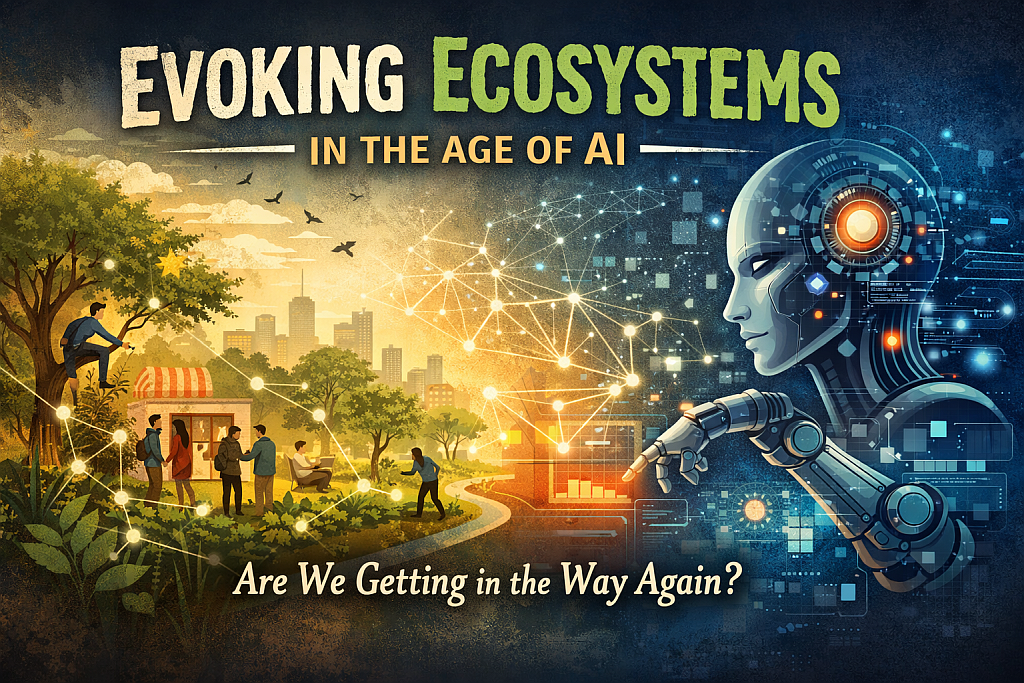
Evoking Ecosystems in the Age of AI: Are We Getting in the Way Again?
In 2020, I posed a question on Medium.com (article here) that made many uncomfortable: “What is an entrepreneurial ecosystem more than the act of removing our institutions and organizations to get them out of the way of the entrepreneurs?”
Four years later, as artificial intelligence reshapes the foundation of how we work, create, and build, I find myself asking a harder version of that same question: Are we about to make the same mistake with AI that we made with entrepreneurial ecosystems?
The parallels are striking and deeply concerning.
When entrepreneurial ecosystems became the fashionable solution to economic development, we watched governments, universities, and organizations rush to “build” them. Frameworks were constructed. Consultants were hired. Initiatives were launched. Money flowed toward the artificial creation of something that, by its very nature, emerges organically when the conditions allow. We confused activity with progress, and in the process, we often created more barriers than we removed.
Now, as AI emerges as perhaps the most profound technological shift of our generation, I see the same institutional impulse rising. Committees are forming. Regulations are being drafted. “AI strategies” are being written. Governance frameworks are proliferating. Everyone wants to “manage” AI, to “guide” it, to ensure it develops “responsibly.”
But I must ask: In our rush to control AI, are we once again constructing elaborate systems to solve a problem we are creating?
Consider what AI fundamentally offers: the automation of bureaucracy, the democratization of capabilities once locked behind institutional gatekeepers, and the potential to remove friction from processes that have long frustrated entrepreneurs. AI could be the ultimate barrier-remover, the very thing that finally creates the space I argued for in 2020. It could automate away the administrative burden that suffocates small businesses. It could provide access to expertise and analysis that was previously available only to those with resources. It could level the playing field that has been tilted for generations.
Yet what are we doing? We are adding layers faster than AI can strip them away.
Every AI ethics board, every approval process, every compliance framework, every “responsible AI” initiative, these may be well-intentioned. Still, they are institutional responses to a force that challenges the very logic of institutions. We are trying to fit a decentralized, rapidly evolving technology into centralized, slow-moving governance structures. And in doing so, we risk recreating the exact environment that entrepreneurial ecosystem research showed us doesn’t work.
I want to be clear: I am not advocating for chaos. I am not suggesting we abandon all caution or ethical consideration. Instead, I am questioning whether our institutional reflexes serve us or are manifestations of an older mindset struggling to maintain relevance in a new paradigm.
The question returns to culture, that intangible conductor I wrote about in 2020.
If culture is the seamless flow that guides an ecosystem, then our cultural response to AI will matter far more than our institutional response. Technology, after all, is neutral. AI will amplify whatever culture we bring to it. If our culture centers on control, compliance, and risk-aversion, then AI will be shaped by those forces—institutionalized, gatekept, and made accessible primarily to those who can navigate bureaucratic mazes. If our culture centers on human creativity, dignity, and shared prosperity, then AI becomes something else entirely.
This brings me back to Humane Entrepreneurship and why it has never been more relevant.
The question has always been: Who sits at the center of our economic systems? Is it the institution, the framework, the regulation, the process? Or is it the human, the entrepreneur, the creator, the community member trying to build something meaningful?
AI forces this question into sharp relief because it moves faster than institutions can respond. By the time a governance framework is written, the technology has evolved. By the time regulations are implemented, new applications have emerged. The traditional institutional approach, study, plan, regulate, implement, cannot keep pace with exponential technological change.
But humans can adapt. Culture can shift. Communities can self-organize. Just as ecosystems in nature find balance through bottom-up processes rather than top-down mandates, entrepreneurial ecosystems responding to AI may thrive most when we trust the humans within them to navigate this transformation themselves.
Who has access to AI tools? Who gets to shape AI applications? Whose voices are heard in AI development? If our institutional responses to AI create barriers, through cost, complexity, or compliance requirements, then we will have replicated the very exclusion that undermines ecosystem health. But if we focus instead on removing barriers, on ensuring access, on centering human needs over institutional preservation, then AI could be the force that finally levels playing fields we’ve struggled to level through policy alone.
The ecosystems that will thrive in this AI-transformed world will not be the ones with the most elaborate AI governance frameworks. They will be the ones who cleared space for their entrepreneurs to experiment, fail, learn, and create. They will be the ones who ask, “What do we need to stop doing?” rather than “What new thing should we build?”
I wrote in 2020 that we must find our seat in the uncertainty of the gray area. That gray area has only expanded. AI brings complexity that defies simple frameworks and certainties that make institutions comfortable. But it is precisely in this uncertainty that entrepreneurship has always lived, where innovation happens, where new possibilities emerge, where humans demonstrate their remarkable capacity to adapt and create.
So I will ask again, with greater urgency than before:
What is an entrepreneurial ecosystem in the age of AI, more than the act of removing our institutions and organizations to get them out of the way of the entrepreneurs?
The answer lies not in what we build, but in what we’re finally willing to let go.
As always, these reflections are meant to provoke discussion, not provide answers. The path forward will not be found in any single framework or theory. It will emerge from our collective willingness to question, to challenge, to sit in discomfort, and to trust that humans, given space and access, will find their way.
It is here we will advance. It is here that entrepreneurship and humanity must lead.
