Small businesses face mounting challenges, but innovative solutions and strategic support are emerging across the globe
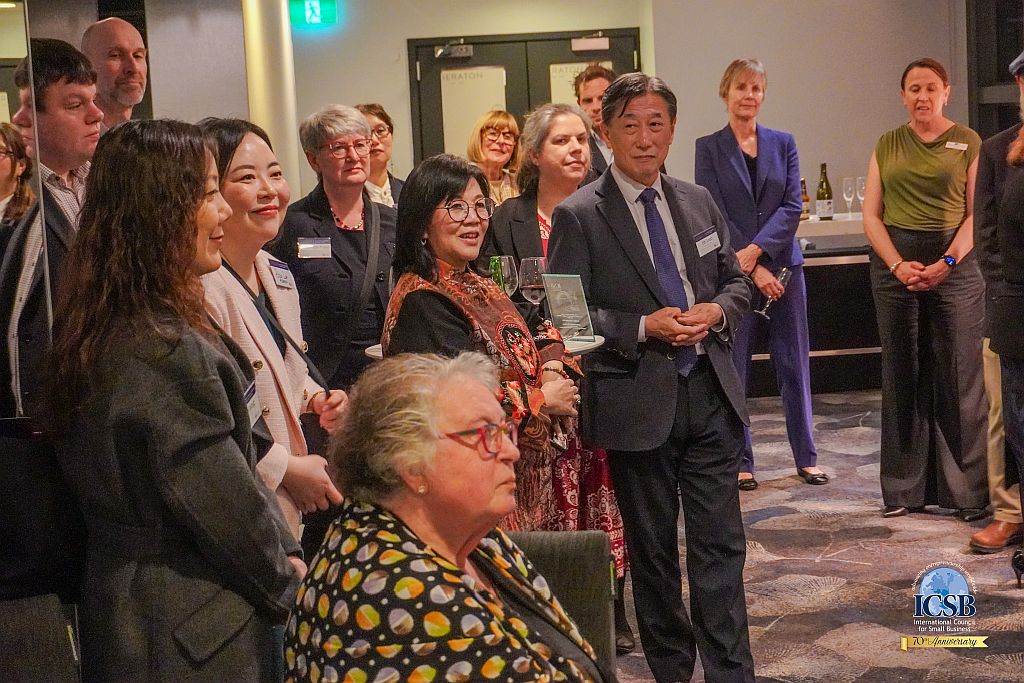
The International Council for Small Business (ICSB) Signature Event in Sydney brought together leading voices in entrepreneurship and small business development, revealing both sobering realities and promising innovations for the sector that forms the backbone of economies worldwide.
The Entrepreneurial Mindset: Action Over Ideas
Cameron McKenzie, CEO of Aspire’s Circular Economy initiative, opened the conference with a powerful reminder: “Entrepreneurs tend to come from entrepreneurial families.” But more importantly, he emphasized that entrepreneurship isn’t about having great ideas—it’s about taking purposeful action, especially when the path forward isn’t clear.
McKenzie’s philosophy centers on practical principles that challenge conventional business thinking:
Reduce bureaucratic burden. For every new policy implemented, roll one back. While policies help steer organizations, they must provide genuine value without creating undue burden for entrepreneurs.
Develop problem-solving mindsets. Entrepreneurs excel at bringing method to madness, transforming chaos into opportunity through systematic thinking.
Fund execution, not just ideas. If acceleration is the goal, invest in results and implementation rather than concepts alone.
Recognize MSMEs as more than economic engines. Small and medium enterprises aren’t just drivers of economic activity—they serve as the conscience of enterprise itself.
From Crisis to Opportunity: The ASPIRE Success Story
McKenzie illustrated these principles through Australia’s response to China’s trade restrictions. When traditional export markets closed, Australia found itself without a backup plan. The Commonwealth Scientific and Industrial Research Organisation (CSIRO) responded by developing ASPIRE—the Advisory System for Processing Innovation & Resource Exchange.
This digital marketplace for material reuse has delivered impressive results:
- Over 5,100 active businesses participating
- $135 million in savings generated
- 1,670 tonnes of resources exchanged and repurposed
ASPIRE demonstrates how MSMEs can become the heart of a circular economy, transforming waste management challenges into value creation opportunities.
The Global Small Business Reality Check
The conference’s first panel session, featuring Hon Bruce Bilson (Australian Small Business and Family Enterprise Ombudsman), Dr HAN Jungwha (Korea Entrepreneurship Foundation), and Dr Reuben Ascua (Universidad Nacional de Rafaela, Argentina), painted a complex picture of the current small business landscape.
Australia’s sobering statistics reveal systemic challenges:
The numbers tell a concerning story about the health of Australia’s small business sector. MSME share of GDP has dropped to just 32%, while their portion of total employment has fallen to 39%. Perhaps most striking: only 3% of all MSMEs employ others, and 45% failed to turn a profit in the most recent tax year.
The demographic trends are equally worrying. Half of small business owners are over 50, with only 8% under 30. Meanwhile, 75% of self-employed individuals earn less than minimum wage, and many businesses operate with less than one week of cash reserves.
Yet there’s a silver lining. May 2025 marked the first improvement in small business conditions since August 2022, with a 0.1% increase providing hope for recovery.
Solutions for systemic change include tax discounts for new businesses in their first three years, regulations appropriately scaled to business size, elimination of unfair trading practices, creation of a federal small business court, and simplified resources and guidance.
International Approaches to MSME Support
Korea’s innovation ecosystem has created 640 digital incubators (TIPS), generating an average of 8.3 jobs per startup. The country focuses on expanding markets, reducing failure costs (both financial and cultural), increasing MSME investment, commercializing technology, promoting fair trade, and enhancing entrepreneurial capabilities.
Argentina’s perspective highlighted how new technologies present unique challenges. With higher risk profiles and less tangible assets, these ventures struggle to secure traditional bank financing, creating a knowledge gap about how to effectively support this evolving sector.
Investment Strategies That Work
The second panel session, featuring Elton Chiu (Kiddie’s Paradise, Taiwan), Dr Reinhard Schulte (Leuphana University, Germany), and Dr Marie-Louise Verreynne (University of Queensland), emphasized human-centered business strategies and practical support systems.
Taiwan’s resilience philosophy centers on believing in yourself through inevitable crises that occur every 2-3 years. The focus should be on creating value, becoming essential to customers, and maintaining unwavering self-confidence.
Germany’s multi-level support model combines direct funding with institutional backing through four public funding programs. While bureaucracy remains a challenge, the comprehensive approach delivers measurable results for MSME development.
Australia’s Queensland approach emphasizes failing fast to accelerate learning, using customer feedback strategically, and fostering stronger collaboration between academic institutions and the business community.
The Path Forward
The ICSB Sydney event revealed a sector in transition. While traditional metrics show concerning trends—declining GDP share, aging ownership demographics, and profitability challenges—innovative solutions are emerging worldwide.
The key insight from Sydney is that supporting MSMEs requires more than funding. It demands systemic change: reducing bureaucratic friction, creating appropriate regulatory frameworks, fostering innovation ecosystems, and recognizing that small businesses serve as both economic engines and the moral compass of enterprise.
As McKenzie concluded, entrepreneurship thrives not on perfect conditions but on purposeful action in uncertain times. The challenge for policymakers, investors, and business leaders is creating environments where this entrepreneurial spirit can flourish while addressing the practical barriers that currently hold back too many promising ventures.
The future of small business isn’t just about statistics and policies—it’s about nurturing the entrepreneurial families and mindsets that will drive the next generation of economic and social innovation.
 Summary compiled by Barbara Maidment EdD, Director and Vice-chair, Practitioners and Business, Small Enterprise Association of Australia and New Zealand (SEAANZ)