The Top 10 Micro, Small, and Medium Enterprises Trends for 2026 – S. Korea
As concerns about “Peak Korea” intensify, Korea’s MSMEs find themselves at the center of a defining national moment. Korea’s Top Ten
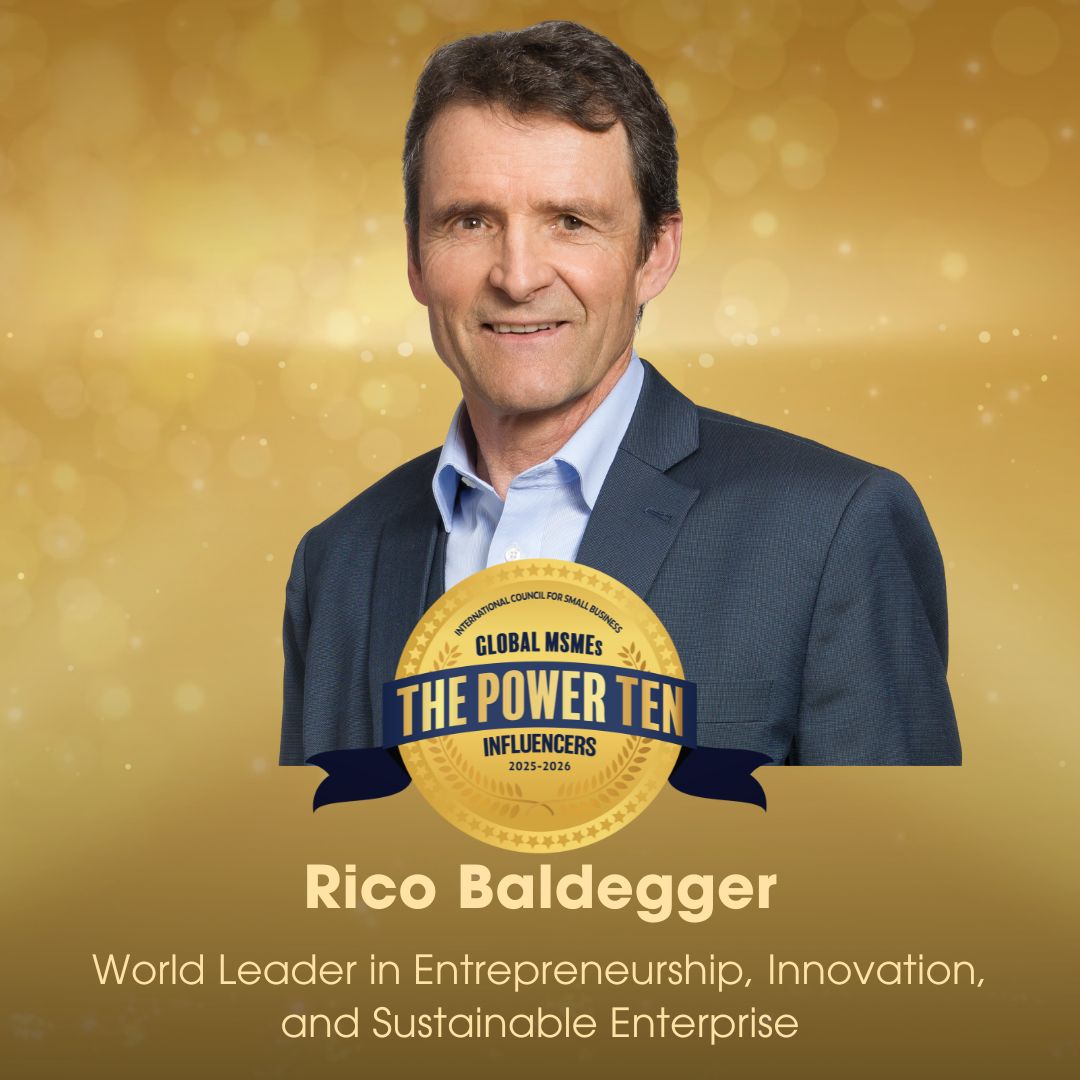
By Dr. Rico Baldegger, ICSB Fellow (2025) and Board Member, and in collaboration with Dr. Ayman ElTarabishy, Preisdent & CEO, ICSB
Europe enters 2026 with growing concern over its lagging pace of innovation and an increasingly heavy burden of bureaucracy that slows entrepreneurial momentum. While talent and ideas remain abundant in spotty areas, complex regulation, fragmented markets, and risk-averse systems continue to obstruct the journey from concept to scale. The central challenge ahead is whether Europe can break through its structural inertia and compete at the speed of the global economy.
By 2026, Europe’s MSMEs and start-ups will be advancing through a triple transition toward AI adoption, regulatory alignment, and sustainability. Yet across all dimensions, Europe faces a defining challenge: innovation moves faster than scaling. The following trends reflect both momentum and the urgent need to accelerate execution.
10
Circular and regenerative models are spreading across sectors. SMEs gain from material efficiency and cost savings, while start-ups innovate in traceability and resource restoration. Adoption remains gradual due to the need for upfront investment and uncertain long-term returns.
09
Cross-border digital operations are becoming easier for SMEs through harmonized frameworks and unified payments. Start-ups increasingly launch as pan-European from day one, though national differences still slow rapid scaling.
08
European automation prioritizes augmentation over replacement. SMEs invest in upskilling workers, and start-ups develop AI copilots for regulated and industrial environments. This builds trust but often delays productivity breakthroughs.
07
Embedded finance and revenue-based funding improve early access for SMEs, while start-ups turn to venture debt and hybrid instruments. However, late-stage growth capital remains limited, slowing the journey from innovation to scale.
06
Resilience now rivals efficiency. SMEs benefit from regional clusters and shorter supply chains, while start-ups deploy micro-factories to protect IP and reduce emissions. Higher costs and fragmentation can constrain flexibility.
05
Employee ownership, steward-ownership, and community-based models are gaining traction. These enhance resilience and mission alignment but can limit rapid international expansion.
04
Public investment is strengthening Europe’s deep tech and climate base. SMEs adapt manufacturing for Green Deal goals, while start-ups develop science-driven industrial solutions. Scaling remains slow due to long development cycles and cautious capital.
03
The EU AI Act and related frameworks are turning compliance into a competitive asset. SMEs leverage transparency for trust, while start-ups use RegTech and sandboxes to manage risk. The challenge is aligning regulatory certainty with faster innovation cycles.
02
AI is no longer optional. SMEs automate operations with generative AI, while start-ups deploy agentic AI to enhance productivity. Many firms remain stuck in pilot mode, reflecting gaps in skills, capital, and integration capacity.
01
Europe’s defining challenge is converting innovation into scalable growth. Despite world-class research and strong early-stage development, many firms struggle to scale across borders due to fragmented markets, limited late-stage capital, risk-averse cultures, and complex regulation. Closing this speed gap—through better scale-up finance, faster market integration, talent mobility, and smarter regulation—will determine Europe’s global competitiveness beyond 2026.
Final Summary for 2026 Top Ten Trends for Europe:
Europe’s entrepreneurial landscape is being reshaped by advances in AI, deep tech, climate innovation, new ownership models, and a stronger digital single market, alongside more human-centered automation and resilient nearshoring strategies. Access to early-stage finance is improving, but the shortage of late-stage growth capital continues to constrain scale. Regulation is evolving into a competitive signal, primarily through frameworks such as the EU AI Act, while regenerative business models are steadily moving into the mainstream. Despite Europe’s strengths in research, ethics, and early innovation, many firms remain trapped at the pilot stage or struggle to expand across fragmented markets. Ultimately, Europe’s central challenge beyond 2026 is closing the speed gap between innovation and scale, which will define its global competitiveness.
Be part of the largest and oldest network of small businesses and entrepreneurs in the world.

As concerns about “Peak Korea” intensify, Korea’s MSMEs find themselves at the center of a defining national moment. Korea’s Top Ten

As Latin America moves through an age of slow growth and global uncertainty, its MSMEs rise as the architects of renewal.
Women are reimagining the future of entrepreneurship. In 2026, women entrepreneurs are not simply building companies; they are building cultures of
Europe 2026 Top Ten Trends for MSMEs: Europe’s entrepreneurial landscape is entering a defining decade. Advances in artificial intelligence, deep tech,