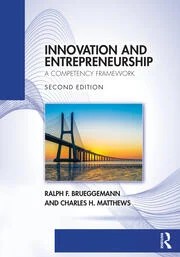
Excited to announce the release of the 2nd edition of Innovation & Entrepreneurship, 2e. The updated edition presents a new model, the competency framework, for students, innovators, entrepreneurs, managers, and anyone who wants to better understand the dynamic world of innovation and entrepreneurship.
Focused on both the individual and strategic organizational level, this book is about people and the competencies each person needs to learn to be successful in creating a more dynamic future. The framework for innovation and entrepreneurship competencies empowers individuals to excel at innovation and new venture creation.
It provides a practical guide and clear and concise understanding of the knowledge, skills, attitudes, and experiences that are needed to increase imagination, creativity, innovation, and new venture creation capability. Innovation and Entrepreneurship will be attractive for students of entrepreneurship, innovation, management, and cross-disciplinary classes, such as design thinking.
Presented in a modular format, Innovation and Entrepreneurship informs the future direction of people and technology, as well as the educational systems producing the next generation of innovators and entrepreneurs.
Based on extensive academic research, this book is organized into two sections: 12 innovation elements and 12 competency categories. The elements are the foundation and the competency categories are the building blocks that inform our path toward a more precise understanding of how innovation and entrepreneurship play an important role in economic development and our daily lives.
From the introduction, these are the key concepts discussed in the 2e.
The focus of this book is how to unlock everyone’s talents to build capability to be successful in the future by learning and applying innovation and entrepreneurship competencies. In general, competencies are the attitudes, skills, and knowledge that are needed to increase imagination, creativity, innovation, and entrepreneurship capability. Fundamental to this process is the concept of the Power of And, a unique model for combining all aspects of innovation and entrepreneurship into a unified framework.
This book is for anyone who wants to improve their ability to generate ideas, develop creative insights, and build innovation and entrepreneurial capabilities. Ultimately, this book is about people and the competencies each person needs to learn to be successful in his or her career while contributing to organizations of their choice. The thesis of this book is that by learning innovation and entrepreneurship through an organized framework, it facilitates learning, drives innovation, and enables successful new venture creation.
Innovators and entrepreneurs are focused on turning ideas which are often seen long before others into action. As discussed throughout this book, innovation and entrepreneurship are not random acts. Rather, they are the result of applying concepts based on evidence, systematic observation, experiences, theory, knowledge, application, experimentation, and more. Moreover, it includes concepts such as the Power of And – a wholistic approach that prioritizes purpose as well as profits to act ethically and succeed financially.[i]
The Role of the Adventurer
To achieve meaningfully significant innovations and ultimately engage in transformative entrepreneurship, one needs to become an adventurer. For example, imagine you are a mountain climber. Do you have all the individual and team capability needed for the climb as well as to encounter the unexpected as you near the peak? While there is always a need for an eye on the future, it cannot be accurately predicted. As a result, moving forward there is always less than full certainty. In order to address significant challenges and opportunities and devise solutions, innovation is critical. That is, doing the same things as done in the past and expecting different results does not work. Rather, there is a need to build the capability, individually and organizationally, to adapt or innovate to address a rapidly changing landscape.
For example, sporting events are zero-sum games resulting in a winner and loser. For-profit and non-profit organizations, on the other hand, do not participate as zero-sum games. Organizations are designed to provide value and produce many winners. However, if there are not effective organizations in place, as determined in part by their effective decision-making capability, failure or loss results. Among the most important elements for effective decision-making are to be robust and nimble, take risks, and be willing to fail intentionally. Intentional experimental failure is good failure because you learn how to be better. If failure is operational, it is not good failure.[ii]
[i] Jeff Bezos, Invent & Wander, (Boston: Harvard Business Review Press, 2021), 230-231
[ii] Freeman, R.E., Martin, K., and Parmar, B., 2020. The Power of And: Responsible Business Without Trafe-Offs, New York, NY: Columbia University Press.
Charles H. Matthews is Distinguished Teaching Professor of Entrepreneurship and Strategic Management, Founder and former Executive Director of the Center for Entrepreneurship Education & Research, and former Director of the Small Business Institute® at the University of Cincinnati, USA. He is an internationally recognized scholar and innovative teacher in the field of entrepreneurship and honored as the United States Association for Small Business & Entrepreneurship (USASBE) as the 2024 Entrepreneurship Educator of the Year.
Ralph F. Brueggemann is Adjunct Professor at the University of Cincinnati, USA. He has over 50 years of experience in all aspects of leadership, management, product management, quality improvement, and technology management in multiple business sectors. He has managed the development of commercial software products and applications, from mobile to high-end software systems.