For decades, we have measured entrepreneurial success through business creation, investment, revenue, and economic growth. Those measures still matter. But perhaps we have been asking the wrong questions.
What if AI adoption does not translate into real productivity? What if access to finance does not lead to sustainable growth? What if scientific breakthroughs never reach the marketplace? And what if entrepreneurial opportunity remains out of reach for too many people?
These are not hypothetical concerns. They describe the gap between what we know about small businesses and what we have managed to change. Researchers have documented barriers to finance, the uneven effects of technology, and the inequalities that shape who can start and grow a business. Knowing these things is not the same as acting on them.
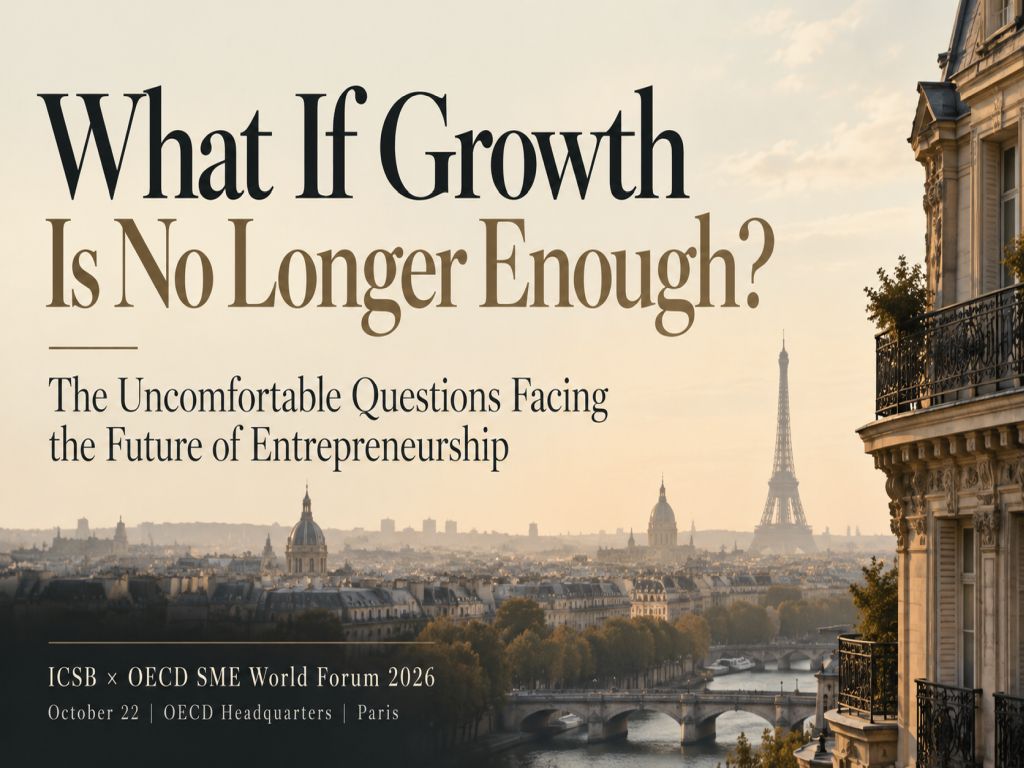
That gap is the starting point for the ICSB × OECD SME World Forum in Paris this October. Policymakers, researchers, and entrepreneurs from institutions including the OECD, the World Bank Group, and the WTO will take up five questions. Each one challenges a familiar assumption about what it means for a small business to succeed.
The questions are worth asking well beyond Paris.
AI: are we measuring adoption or progress?
The number of small businesses using AI is rising. That figure tells us very little about whether those businesses are more productive, more resilient, or more profitable. Adoption is an input. Progress is an outcome.
Large corporations can afford to experiment with AI, absorb failed pilots, and build internal expertise. Small firms compete on different strengths: creativity, agility, and how quickly they adapt. Whether AI narrows the gap between large and small firms or widens it depends on which of these advantages the technology rewards.
The better measure of AI’s success is not how many small businesses adopt it. It is how many turn that adoption into meaningful economic value. Policy built around adoption rates risks celebrating activity instead of results.
Finance: are we financing the past or the future?
Traditional financial systems are built to evaluate what a business has already accomplished. They are far less equipped to judge what it might become. Yet many of the most promising entrepreneurial ideas come from enterprises with no financial history to evaluate.
Consider a hypothetical example: two firms applying for the same loan. One is a family distributor with ten years of steady revenue and a warehouse to pledge as collateral. The other is a two-year-old company building low-cost soil sensors for small farms, with a strong team, a handful of pilot customers, and almost no assets. Most lending models will favor the first, even if the second has far greater potential to create jobs and value.
Access to capital is also only the first step. Getting financing and building a sustainable, growing enterprise are not the same. The harder question is whether financial systems can learn to recognize potential and create the conditions for promising businesses to scale.
Deeptech: what happens after the discovery?
Universities and laboratories are producing extraordinary scientific breakthroughs. Far fewer of those breakthroughs become successful enterprises. The path from discovery to market has been studied extensively, yet it remains one of the hardest stretches of the entrepreneurial journey to cross.
Technical uncertainty can remain a real barrier. But the challenge often lies beyond discovery itself, in the institutions, partnerships, and ecosystems needed to turn knowledge into economic and societal value: people who can build a company around a technology, patient capital willing to wait for it, and networks that connect researchers to markets.
The next great entrepreneurial breakthrough may depend less on another invention and more on stronger bridges between science and society.
Women and youth: who actually gets the opportunity to grow?
Entrepreneurship is often celebrated as a pathway to opportunity. Those opportunities are not distributed equally. Starting a business and building a sustainable enterprise are different achievements, and the distance between them varies for everyone.
Access to networks, financing, mentorship, and institutional support often determines who can make that move. Women entrepreneurs and young founders often find these resources harder to reach.
This raises an important distinction. Are we simply encouraging more people to become entrepreneurs, or are we creating better conditions for entrepreneurs to flourish? Counting new founders is easy. Knowing whether they have a real chance to grow is harder, and it matters more.
Emerging topics: what are we not talking about yet?
Some of the most consequential changes in entrepreneurship receive the least attention today. Demographic shifts, evolving trade relationships, intergenerational businesses, new forms of work, and the changing relationship between technology and society are already testing familiar assumptions about how small businesses operate.
The question is not only which trends will shape the next decade. It is what we overlook today that future generations will take for granted.
Foresight is a discipline, not a guess. It requires listening to people who see the system from different positions: those who shape trade rules, those who finance development, those who study entrepreneurs, and those who publish the research that defines the field.
The conversations in Paris will help inform ICSB’s Top Ten Trends for MSMEs, connecting what emerges there to future research, policy priorities, and international collaboration.
The bigger question
Together, these five questions broaden how we think about entrepreneurial success, moving beyond conventional measures to consider productivity, access to opportunity, innovation, inclusion, and our ability to anticipate change.
They will be at the center of the ICSB × OECD SME World Forum in Paris, October 21 to 23, 2026, where researchers, policymakers, and entrepreneurs will explore what the next chapter of small business development should look like. Explore the full program.
But the question extends well beyond any single forum. If we keep measuring entrepreneurial success mainly by business creation, investment, and economic growth, we risk overlooking the people and communities those achievements are meant to serve.
Growth matters. It creates opportunity, generates resources, and helps businesses survive. But growth is a means, not the destination. The deeper measure of entrepreneurial success is whether it expands people’s opportunities to live meaningful, productive, and fulfilling lives.
Perhaps the future of entrepreneurship is not about choosing between economic growth and human flourishing. It is about understanding that growth achieves its greatest purpose when people flourish.