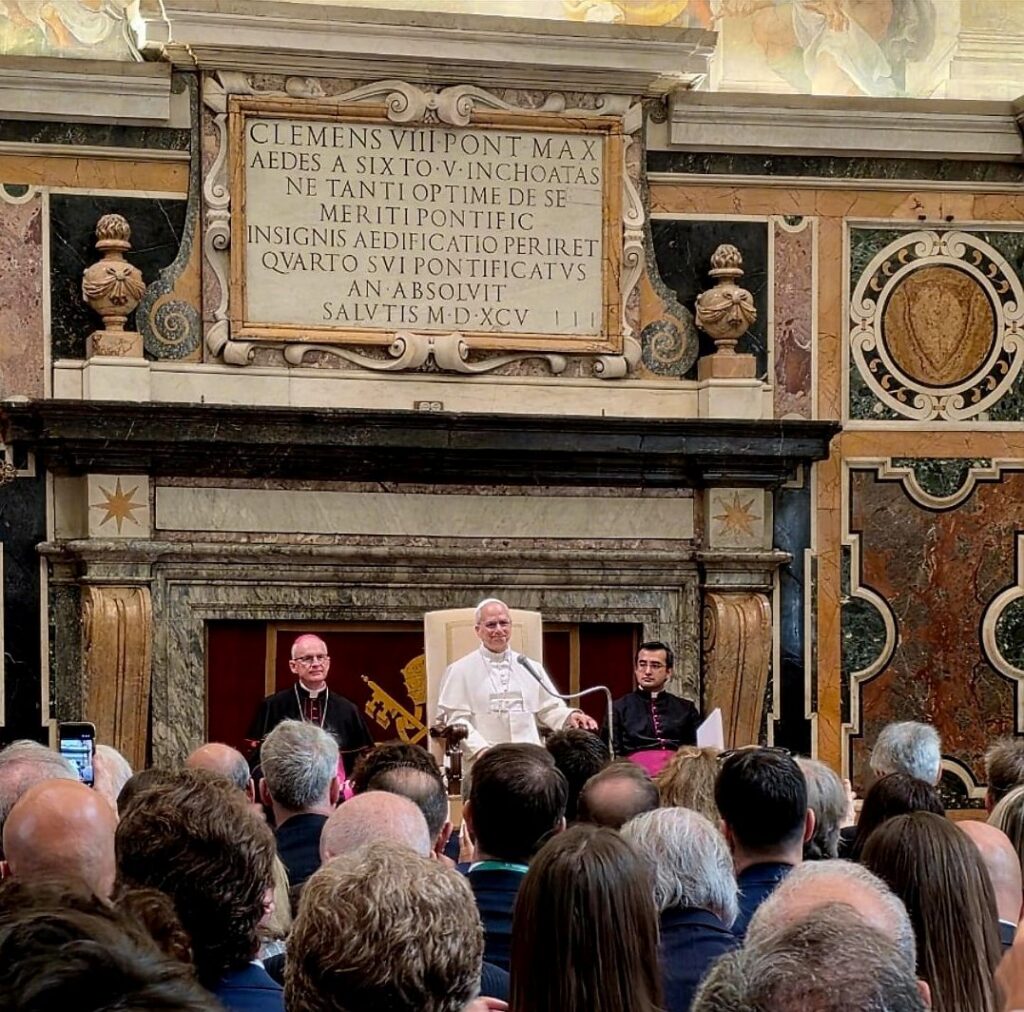
ICSB Chairman Ki-Chan Kim makes the case for the world’s smallest businesses at the Vatican, answering Pope Leo XIV’s first AI encyclical with a 70-year-old Korean bakery.
VATICAN CITY, May 29, 2026 — His answer to the Pope’s warning about artificial intelligence was not a tech company. It was a bakery.
Ki-Chan Kim walked into the New Synod Hall and made a simple argument. Technology should serve people, not replace them. The proof, he said, sits in a Korean shop that gives away one loaf for every two it sells.
Kim is Chairman of the International Council for Small Business (ICSB) and Professor Emeritus at the Catholic University of Korea. He delivered the address at the General Assembly of the Pontifical Foundation Centesimus Annus Pro Pontifice and the FCAPP 2026 International Conference. The gathering brought together Catholic leaders, scholars, business executives, and policymakers to examine the ethical challenges posed by artificial intelligence and economic change. For decades, ICSB has pushed a single idea: entrepreneurship should put human dignity, community, and opportunity first. On Friday, Kim gave it a name. He called it the Human-Centered Entrepreneurship Revolution.
He tied it straight to the news of the week. On May 25, Pope Leo XIV released his first encyclical, Magnifica Humanitas, a warning against reducing the human person to data, function, or tool in the age of AI. Kim set it in a hundred-year line, from Leo XIII’s Rerum Novarum in 1891 to John Paul II’s Centesimus Annus in 1991. Each defended people against the machine of its era. The question now, he said, is blunt. Will technology replace us, or serve us?
Human-centered entrepreneurship, Kim argued, is how you put the encyclical to work.
Then he told the story of Sungsimdang.
The bakery opened in Daejeon in 1956. Its founder, Im Gil-soon, was a devout Catholic who built the business on one rule. Sell two loaves. Give one away. Seventy years later, the rule still holds. Kim noted that the bakery recently received recognition from Pope Leo XIV for its commitment to an “Economy for All.”
Generosity did not slow the company down. It powered it. Kim said Sungsimdang has averaged about 43 percent annual growth over the past five years, with operating margins near 25 percent, roughly five times the typical small business. “The more you share, the more you grow,” he told the room.
His framework is UIT, mapped to three E’s. Understand people (Empathy). Invest in people (Enablement). Trust people (Empowerment). Apply all three, he said, and even a dying company can come back. “If only 100 human-centered companies were created around the world, capitalism itself could change.”
 The model scales. While Sungsimdang shows the idea at the corner-shop level, Kim said the same philosophy can drive a giant. He pointed to Samsung Electronics, which this week pledged a 5 trillion won fund, about 3.3 billion dollars, for partner companies, vulnerable groups, and future talent over five years. Same spirit, bigger stage.
Kim closed with a call for a “Fifth Industrial Revolution” built on sharing, and a “Neo-Renaissance” in which people think and create while machines handle the routine work.
“Dream big. Start small. Move fast,” he said. “If every country can create just one company like Sungsimdang, we can change the future of capitalism.”
The message from the Vatican was direct. AI will not decide the future. People will. And the businesses that win, Kim argued, will be the micro, small, and medium-sized enterprises (MSMEs) that lift people up on the way.
For ICSB, the message extends beyond theory. The organization has spent decades championing the role of MSMEs worldwide. In 2017, ICSB President Dr. Ayman Tarabishy helped lead the effort that established United Nations MSMEs Day, now recognized annually on June 27 by the UN General Assembly.
The day honors the small businesses that form the backbone of economies around the world. Sungsimdang is one of them.
Kim’s case at the Vatican was, ultimately, a case for the millions of entrepreneurs who prove that growth and human dignity can advance together.