What Comes Next?
GDP measures what economies produce. HDI measures the foundations of a good life. This fall, ICSB takes up the question of what comes next—from Washington to Seoul to the ICSB-OECD SME World Forum in Paris.
For most of the last century, the world measured a nation’s success with a single number. Gross Domestic Product told us what an economy produced. It became the number governments chased, and policies were designed to raise.
GDP is a powerful measure. It is also a narrow one. It counts what we make. It says little about the people who make it.
In 1990, the United Nations offered a correction. The Human Development Index kept income in the picture but added two dimensions GDP had largely ignored: health and education. It put one number beside GDP and made a quiet but radical claim: development is about people, not just output.
HDI changed the global conversation. More than three decades later, it remains one of the world’s most widely recognized measures of human development.
But HDI stops where another important question begins.
It tells us whether people live long, learn, and earn. It does not tell us whether they are flourishing in their daily lives. It does not tell us whether they have the freedom, agency, and opportunity to build something new.
HDI measures the foundations of a good life. It does not measure the life itself.
That gap is where the work of the International Council for Small Business now turns.
A First Step—and What It Revealed
Earlier this year, ICSB President Ayman ElTarabishy published research in the Journal of the International Council for Small Business introducing the Human-Centered Entrepreneurship Index.
The Index brings two major global measurement systems into a single view. Drawing on the Gallup World Poll, it examines dimensions of human flourishing: Are people thriving in how they evaluate their lives? Do they have stable work? Are they engaged in what they do? Drawing on the Global Entrepreneurship Monitor, it examines entrepreneurial dynamism: Are people pursuing opportunities? Are they innovating? Are they building what comes next?
Across 43 economies, the data revealed something both sobering and clarifying: human flourishing and entrepreneurial dynamism do not automatically rise together. Please view interactive website here: https://icsb.org/hce-index/
An economy can flourish without creating enough new opportunities. It can create at extraordinary speed without its people flourishing alongside that growth. The comfortable assumption that more entrepreneurial activity automatically produces better human outcomes does not hold.
The relationship has to be measured, not assumed.
This finding sits at the heart of the Human-Centered Entrepreneurship work that ICSB has advanced for more than a decade with Ki-Chan Kim, grounded in a single conviction:
The human is not a constraint on the economy. The human is its purpose.
This is not a conversation ICSB is having from the sidelines.
In June, the Council convened its 71st ICSB World Congress at the George Washington University School of Business in Washington, DC, bringing together the global small-business community. Days earlier, at the United Nations, ICSB presented its work on Human-Centered Entrepreneurship during the MSMEs Day International Forum in the ECOSOC Chamber.
It was a fitting stage. ICSB helped lead the global effort that resulted in the establishment of UN MSMEs Day through UN General Assembly Resolution A/RES/71/279, with June 27 now recognized around the world as a day to elevate the role of micro-, small and medium-sized enterprises.
For ICSB, the question of how we measure human progress is therefore not abstract. It is part of a much larger body of work connecting entrepreneurship, human well-being, and public policy.
The Question We Are Taking Up
The Human-Centered Entrepreneurship Index was a first step; what it revealed points toward a larger question.
If human flourishing and the human drive to create are both essential—and if they do not automatically occur together—then we need a way to see both at once.
The progression is worth stating plainly.
GDP asked: What do economies produce?
HDI asked: Do people have the foundations for a good life?
The Human-Centered Entrepreneurship Index asked: Do human flourishing and entrepreneurial dynamism actually coexist?
What we learned opens the next question:
Can we capture both in a single headline measure of human-centered progress?
Can one measure, standing alongside GDP and HDI, tell us not only whether people have the foundations for a good life, but whether they are actually flourishing—and whether they have the freedom, agency, and opportunity to create what comes next?
That is the question ICSB is taking up this fall.
Led by Ayman ElTarabishy and Ki-Chan Kim, and developed through the work of the Council, it is the thread that will connect the next chapter of our global conversation.
Three Cities. One Conversation.
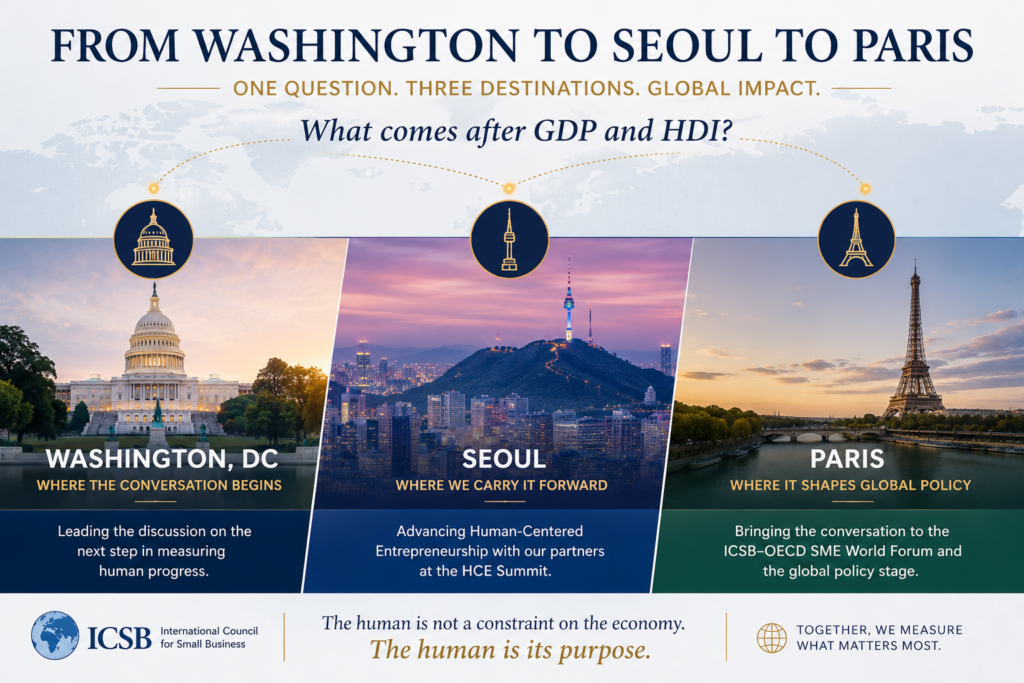
The conversation will unfold across three global stages.
Washington, DC — where the conversation begins, at the home of the Council.
Seoul — where we carry it forward with our Korean partners and the global Human-Centered Entrepreneurship community.
Paris — where it reaches the ICSB-OECD SME World Forum and joins the broader global policy conversation about what comes after GDP.
We are not giving away the answer yet. It deserves to arrive complete rather than early.
But the question itself matters—and too few institutions are asking it.
GDP measured what we produce.
HDI measured whether people have the foundations for a good life.
Now we must ask whether people are flourishing—and whether they have the freedom, agency, and opportunity to build what comes next.
This is the work of the season ahead, and this community is where it belongs. We invite every ICSB member to join us—in Washington, in Seoul, in Paris, and in the conversation connecting them.