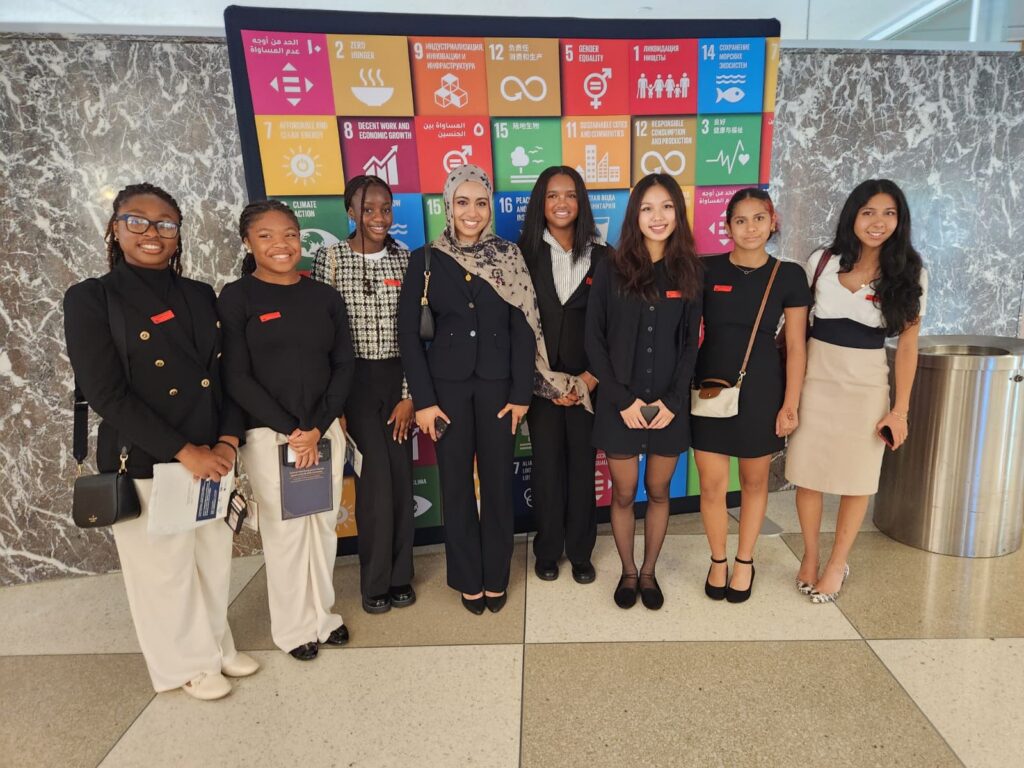
Eight young women walked into the United Nations with something to say.
Some were university students. Some were still in high school. One was in middle school.
But on June 26, those distinctions mattered a little less.
At the MSME Day Youth Forum at United Nations Headquarters in New York, each of them was given the same thing: a global stage, a microphone, and the opportunity to share an idea that was entirely her own.
For a few minutes, the room belonged to them.
The speakers were:
- Alina Sharifi, University of Pittsburgh, PA
- Priya Tapia-Pereira, Bucknell University, PA
- Mireya Tapia-Pereira, Silver Spring International Middle School, MD
- Adaeze Acholonu, Phillips Exeter Academy, NH
- Anjola Agboola, Phillips Exeter Academy, NH
- Lucy Lu, Duke University, NC
- Tiffany Egwim, University of Maryland, MD
- Tessa Egwim, Springbrook High School, MD
Look at that list again
Two of the pairs are sisters, the Tapia-Pereiras and the Egwims. And the speakers ranged from middle school to university, holding the same room. A fourteen year old and a university senior addressed the same audience of ambassadors and agency heads, and neither was there as a mascot for the other.
The sisters are not a coincidence of scheduling. An older sister does something visible and difficult, and a younger sister decides it is available to her. Sometimes the most powerful pipeline is not institutional at all. It runs through a family.
Why the MOMS Network does this
Behind every conversation about the next generation of women entrepreneurs is an earlier question: what conditions made it possible for those young women to imagine themselves there in the first place?
The International Council for Small Business (ICSB) has invested in young entrepreneurial leaders for decades, and the MOMS Network exists because that investment does not begin at the university gate. It begins at home, in the economic and social conditions that mothers navigate every day.
That is the ground the MOMS Network shares with Make Mothers Matter (MMM), an international NGO founded in 1947 that advocates for mothers at the United Nations, the European Union, and UNESCO. MMM works across Mothers and the Economy, Mothers and Health, and Mothers and Peace, with education underpinning all three.
The overlap with our own work is direct. Mothers and the Economy is also, fundamentally, a small business question. Unpaid care work, interrupted careers, and access to capital are not adjacent to entrepreneurship policy. They sit at the center of it.
The work behind the podium
Preparing for a platform of this size took months. The students drafted, cut, rehearsed, and rewrote. Several had never spoken to an audience of that scale, and none of them had spoken to one composed of ambassadors and agency heads. Watching them grow in confidence and sharpen what they wanted to say was the most rewarding part of the process.
None of it would have happened without parents, teachers, mentors, and school communities who cleared the time and encouraged these students to take the opportunity seriously.
What comes next
The Youth Forum was a launchpad, not a ceremony. ICSB congratulates Alina, Priya, Mireya, Adaeze, Anjola, Lucy, Tiffany, and Tessa, and will keep building platforms like this one.
But the measure of the day is not only what happened on the stage. It is what happens in the houses these eight went home to, where a younger sister watches, and quietly moves the whole thing into range.
Written by: Linda Acholonu and contribution by Ayman ElTarabishy