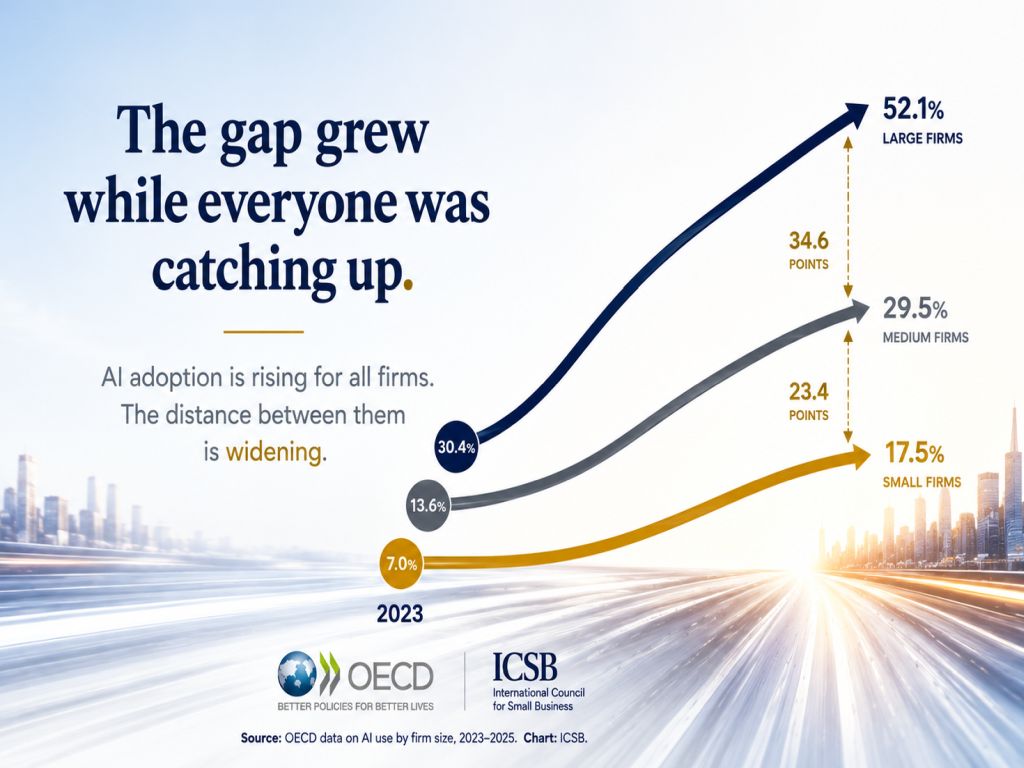
Between 2023 and 2025, small firms across OECD economies more than doubled their use of artificial intelligence. Adoption went from 7 percent to 17.5 percent. Among medium-sized firms it went from 13.6 percent to 29.5 percent. By any ordinary standard that is a success story, the kind of number a minister puts in a speech.
 Here is the number that belongs next to it. Over the same two years, large firms went from 30.4 percent to 52.1 percent. The small firms ran faster and finished further behind.
The tools got cheaper and easier and more available to everyone, and the distance still widened. Generative AI lowered the entry barrier. It did not lower the barrier to the strategic, integrated uses where the actual productivity lives. Most small firms are standing at the first door. The gap is at the second one. Adoption is not the same as capability.
That is the shape of the problem this forum was built to examine, and it is not confined to AI. It repeats, with different variables, across nearly every question in entrepreneurship policy right now.
Look at scaleup finance. A great many countries have learned how to start high-potential companies. Very few have learned how to grow them. Scaling consumes capital at a rate that founding does not, and it consumes it precisely when a company is often still pre-revenue. So the promising firms hit the wall, and the ones with options relocate to somewhere that has capital, and the country that funded the science watches the value leave. The startup rate looked fine the whole time.
Look at who is founding these companies. Women-led startups receive about 2 percent of global venture capital. Young founders, asked directly in the most recent Flash Eurobarometer, named access to capital as their largest barrier. Educational attainment has risen. Digital connectivity is close to universal. The inputs improved and the outcome did not, which tells you the constraint was never really the inputs.
Look at deeptech, where the mismatch is structural rather than distributional. Ventures built on genuine scientific discovery need patient capital, long timelines, testing infrastructure, IP frameworks, and industrial partners, and they need founders who can hold both the science and the business. Almost none of our entrepreneurship support systems were designed for any of that. They were designed for a different kind of company, they work well for that company, and deeptech keeps arriving at the door not quite fitting through it.
And look at family businesses, which account for a majority of firms and jobs across OECD economies and receive a fraction of the policy attention that share would justify. A large cohort is approaching succession at once. Where planning is thin, the outcome is not a difficult transition but a closure, and with it the loss of jobs and of expertise that took three generations to accumulate. Alongside that sit the entrepreneurs balancing ownership with caregiving, most visibly mothers running family enterprises, who face a mix of time and financing constraints that mainstream programs were never designed to see.
Five themes. One recurring question. Why do support systems that are working keep working for a narrowing set of firms?
ICSB has spent the past decade building an answer. Human-centered entrepreneurship begins with a simple proposition: ecosystems fail not because they lack tools, but because they misdiagnose the people those tools are meant to serve. Empathy is the capacity to understand what a founder actually faces. Enablement is what you build once you understand it. Empowerment is what happens when the founder no longer needs you.
Read the five gaps again in that order and they stop looking like five separate policy failures. The mother running a family enterprise is not underserved because programs lack funding. She is underserved because they were designed by people who did not picture her. The deeptech founder does not fail a fitness test. The test was written for someone else. The small firm that adopted AI and fell further behind was given a tool and not the conditions to use it. In every case the enablement was real and the empathy came second, or did not come at all. That order is the finding.
This is why the OECD and ICSB are convening in Paris. For more than six decades the OECD has helped governments understand how economies actually work rather than how they were supposed to work on paper, and through its Centre for Entrepreneurship, SMEs, Regions and Cities it made small business a subject of serious policy rather than an afterthought. ICSB has spent seventy years working where that policy either lands or does not, inside firms, families, classrooms, and ecosystems. Neither view is sufficient alone. The data tells you the gap widened. The practice tells you why.
Over the coming weeks we will open each of the five themes and put the questions directly to the people who study them and the people who live them. Extended abstracts are now being accepted.
The next generation of entrepreneurship policy will not be judged by how many firms it reaches. It will be judged by how many firms it enables to thrive.
That conversation begins in Paris.
Paris | 21-23 October 2026
OECD Headquarters • Station F • French Senate
Submit your research. Shape the conversation.
Exploring new frontiers
One question. One conversation. One step closer to Paris.