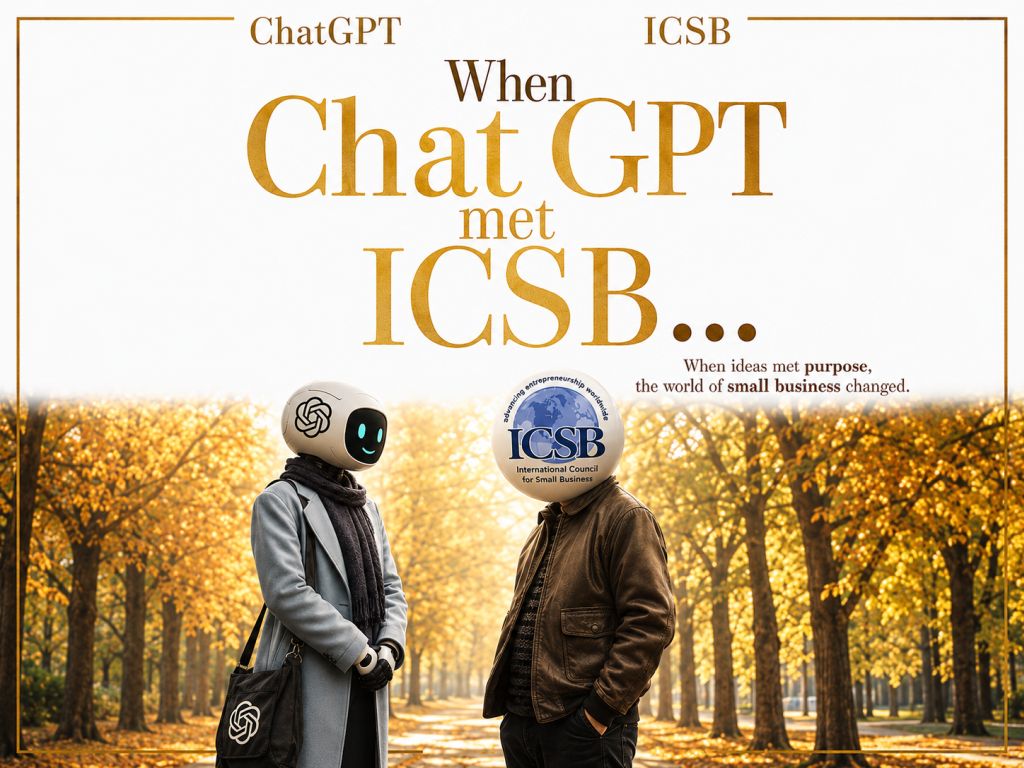
Something new is happening at ICSB.
For years, we thought about how people discovered our work in fairly familiar ways.
They searched Google.
They opened the ICSB Sunday Times.
They followed a link from LinkedIn.
They heard about an ICSB program or event from a colleague.
Now there is another door: artificial intelligence.
 Our new ICSB website intelligence system is showing us something we had never seen before. Readers are arriving at ICSB.org from ChatGPT, Gemini, Claude, Perplexity, and Copilot. Since June, AI assistants have generated more than 500 visits to ICSB.org—and 83% of the identifiable AI-assistant traffic has come from ChatGPT.
But perhaps even more interesting is what people are finding.
Our analytics show that articles published across several years continue to attract significant traffic. Some are being rediscovered through search, some through new referral channels, and others simply continue to perform long after their normal publishing cycle should have ended.
So this week, instead of us deciding what you should read, we decided to let the data tell us.
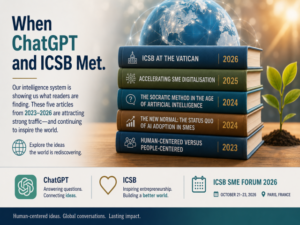
Five Articles People Are Still Finding
2026 — ICSB at the Vatican
One of our newest stories takes Human-Centered Entrepreneurship into an extraordinary setting.
At the Vatican, the conversation went beyond entrepreneurship as a measure of economic performance. It asked what entrepreneurship looks like when human dignity, purpose, and human flourishing become part of how we define progress.
2025 — Accelerating SME Digitalization
We knew this was coming…
In 2025, we were already examining the growing digital divide facing SMEs. Technology was accelerating, but smaller firms lacked the same resources, capabilities, or access as larger companies.
Now, in 2026, the challenge is even clearer. AI adoption among SMEs is rising rapidly, but larger firms are moving even faster.
So we are taking this conversation to Paris.
At the SME World Forum 2026 at the OECD, SME digitalization, AI adoption, skills, and competitiveness will be at the center of the discussion. What we were writing about in 2025 has become one of the defining SME questions of 2026:
How do we make sure SMEs are not left behind?
Read: Accelerating SME Digitalization
2024 — The Socratic Method in the Age of Artificial Intelligence
I wrote this one myself in September 2024.
My argument was simple. If AI can give students answers almost instantly, perhaps education needs to place even greater value on questions, dialogue, critical thinking, and our ability to explain what we actually know. I argued that one of our oldest teaching approaches—the Socratic method—might become even more valuable in the age of AI.
And then something interesting happened.
The idea started showing up everywhere.
In 2025, EDUCAUSE featured a higher-education session specifically examining the Socratic questioning method in the age of AI. And in March 2026, the Associated Press reported that colleges are increasingly returning to oral assessments and Socratic-style questioning as professors grapple with a very modern problem: students can submit excellent AI-assisted work but may struggle to explain what they actually know. Cornell, Penn, and NYU were among the examples.
Sometimes an idea from ancient Greece turns out to be remarkably useful in 2026.
Read my 2024 article: The Socratic Method in the Age of Artificial Intelligence
See the 2026 AP story: Why colleges are turning to oral exams to combat AI
2024 — The New Normal: The Status Quo of AI Adoption in SMEs
Before today’s explosion of attention around generative AI, we were already asking what AI adoption would actually mean for smaller businesses.
Who adopts first? Who gets left behind? And what happens when technological change moves faster than SME capabilities?
Two years later, those questions haven’t disappeared. They’ve become more urgent.
Read: The New Normal — The Status Quo of AI Adoption in SMEs
2023 — Human-Centered Versus People-Centered
This may be the most interesting one.
Published three years ago, Human-Centered Versus People-Centered continues to attract readers, including substantial traffic through organic search.
Why?
Perhaps because the question hasn’t gone away: What does it actually mean to put the human being at the center?
Today, as AI becomes embedded in organizations, entrepreneurship, education, and everyday work, that question may matter even more than it did when the article was written.
Read: Human-Centered Versus People-Centered
What Happens Next?
These articles weren’t selected because they are the newest publications from ICSB.
They were selected because our data is telling us people are finding them.
Now we’re going to watch what happens next. Which ideas continue traveling? Which attract new readers? Which countries respond? What does Google rediscover? What does ChatGPT surface? And what happens with Gemini, Claude, Perplexity, and whatever comes next?
Perhaps the shelf life of a good idea is much longer than the shelf life of a newsletter.
And perhaps that is the bigger lesson:
Don’t just ask what we published this week. Ask what the world is still reading.
Pour yourself an iced tea and explore what the world is rediscovering from ICSB.
— Ayman ElTarabishy
President & CEO
International Council for Small Business