
In 1979, an MIT report upended economic orthodoxy by arguing that small firms, not corporate giants, created most new jobs. It made its author’s name.
Fifteen years later, he corrected himself.
The engine wasn’t small firms. It was fast-growing ones. David Birch called them gazelles — depending on the period and definition applied, somewhere around 3–4% of firms, responsible for the large majority of net job creation.
That insight is no longer a provocation. It is built into official statistics. The Eurostat-OECD Manual on Business Demography Statistics formally defines high-growth enterprises and treats gazelles as their young subset — a measured category, tracked across countries.
The numbers still hold
Recent OECD evidence confirms the pattern with contemporary data.
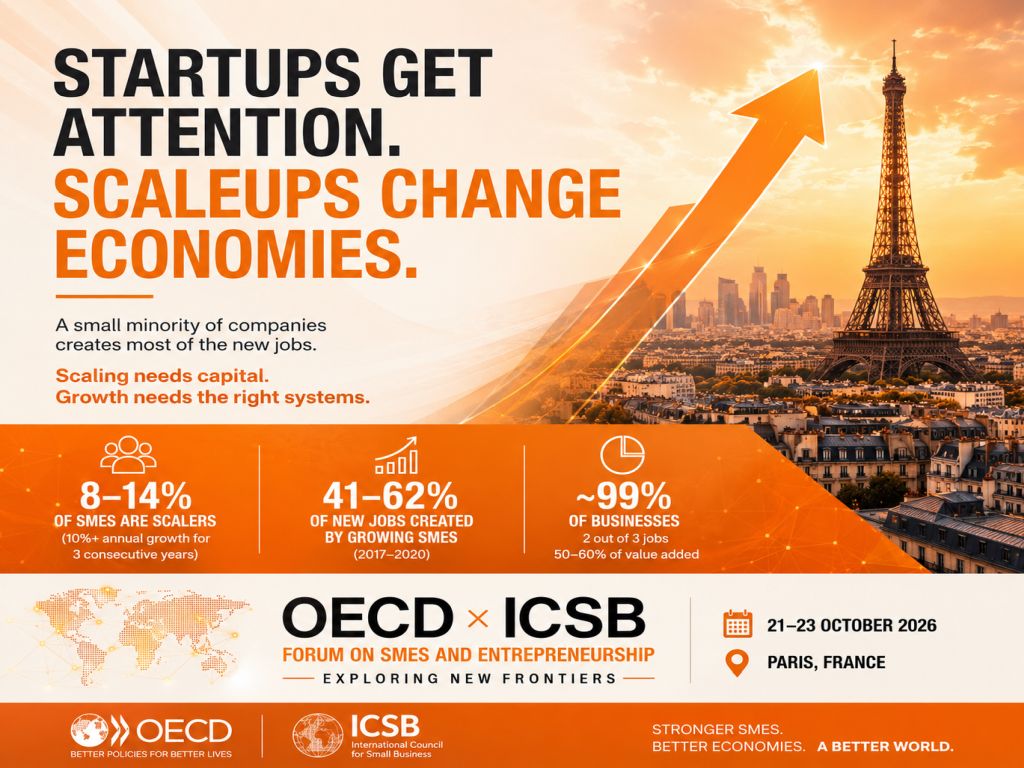
The OECD calls them scalers: SMEs with 10–249 employees growing at least 10% a year over three years. In 2020, employment scalers represented just 8–14% of all SMEs. Yet between 2017 and 2020, they generated between 41% and 62% of every new job created by growing SMEs across the countries with available data.
A sliver of the business population. Most of the job creation.
So we know which firms matter. We have known for thirty years. We have built the indicators to count them.
We still haven’t built financing systems capable of funding enough of them.
Starting is not the same as scaling
Many countries have become genuinely good at helping companies start. Incubators, accelerators, grants, competitions, startup visas, entrepreneurship curricula — the infrastructure of company formation is now mature in much of the OECD area.
Far fewer countries have built what those companies need next.
Scaling is resource-intensive in a way that launching is not. It means recruiting personnel, developing new products, entering new markets and investing in new facilities — and for nascent companies, often still at the pre-revenue stage, it means doing all of it before the money comes in. Shortage of scaleup finance is one of the largest constraints on their development.
The consequence is visible in the data. Young scaleup companies are highly concentrated globally: a few dense clusters, and a great deal of empty space. In many countries, the most promising young growth companies either fail to commercialise their products or relocate to take the next step in their growth journey.
The startup was created. The scaleup happened somewhere else.
Governments are spending. The question is how.
This is not a problem policymakers have ignored. Governments are investing significant sums in closing the financing gap: public investment vehicles, co-investment initiatives, support for angel networks, regulatory reform to streamline investment procedures or deepen capital markets, and investor tax incentives.
What they face is not indifference but genuine uncertainty about design. Should public funds invest directly into scaleups, or indirectly into private funds through a fund-of-funds approach? Which types of investors should qualify for tax incentives? Should resources concentrate on specific sectors and company profiles, or stay neutral?
These are not technical footnotes. They determine whether public money crowds private capital in or pushes it out.
Why this belongs at the centre of policy
SMEs represent around 99% of all firms across OECD countries, employ two out of three workers, and account for 50–60% of value added.
This is not a niche policy file. It is the economy.
ICSB has made that argument for decades. It is why we went to the United Nations — and why, on 6 April 2017, the General Assembly adopted Resolution A/RES/71/279, designating 27 June as Micro-, Small and Medium-sized Enterprises Day. The resolution was authored by the Permanent Mission of Argentina with ICSB’s support, following ICSB’s advocacy at the UN.
This October, we bring the argument to Paris with the OECD.
The question on the table is not whether entrepreneurship matters. It is whether our policies are designed to create more startups — or to help the best ones become something much bigger.
OECD–ICSB Forum on SMEs and Entrepreneurship: Exploring New Frontiers
21–23 October 2026 · OECD Headquarters, Paris
Sessions across the three days will address deeptech entrepreneurship and incubation, scaleup finance, women and youth entrepreneurship, SME AI adoption and skills, and the family and generational dimensions of enterprise.
Registration and programme details →
References
- Birch, D. (1979), The Job Generation Process, MIT Program on Neighborhood and Regional Change, Cambridge, MA.
- Birch, D. & Medoff, J. (1994), “Gazelles”, in Solmon, L. & Levenson, A. (eds.), Labor Markets, Employment Policy and Job Creation, Westview Press. Reported shares vary by period and definition across secondary accounts of this work.
- Eurostat/OECD (2007), Eurostat-OECD Manual on Business Demography Statistics, OECD Publishing, Paris.
- OECD (2025), Unleashing SME Potential to Scale Up, OECD Publishing, Paris.
- OECD, Committee on SMEs and Entrepreneurship (CSMEE).
- UN General Assembly Resolution A/RES/71/279, adopted 6 April 2017.