From Seoul to Andong to Busan and then to Jinju, Ayman ElTarabishy and Ki-Chan Kim are bringing a new measure of economic progress into the public conversation.
SEOUL, South Korea — October 21, 2026
South Korea has spent decades building one of the world’s most innovative economies. But a different question is drawing attention: Is economic success enough if people aren’t flourishing?
That question emerged across a series of international gatherings in Seoul, Andong, Busan, and Jinju this October, where the International Council for Small Business (ICSB) introduced a new way of thinking about national progress.
Korean media took notice.
An ICSB analysis of coverage between October 6 and 20 identified 16 distinct articles across 10 outlets. Recurring themes included human-centered entrepreneurship, youth opportunity, artificial intelligence, and measuring economic progress.
At the heart of the conversation was Gross Domestic Humanity (GDH), a framework jointly developed by Dr. Ayman ElTarabishy, President and CEO of ICSB, and Professor Ki-Chan Kim, ICSB Chair.
GDH builds on the Human-Centered Entrepreneurship Index, which ElTarabishy developed and published in 2026. The research compares 43 economies and examines entrepreneurial activity alongside human flourishing.
Its findings highlight an important contradiction in South Korea: The country ranks among the strongest in entrepreneurship, yet substantially lower in human flourishing.
In an October 16 article published by eToday, ElTarabishy explained GDH’s central question: whether economic progress is actually helping people flourish.
ElTarabishy and Kim introduced the framework at Korea’s National Assembly on October 15, bringing their longstanding academic collaboration into a national policy discussion. Read more here.
Kim subsequently presented the GDH Korea Country Report, examining how the country could translate entrepreneurial strength into better jobs, opportunities for young people, and greater well-being.
 In a separate eToday column, Kim captured Korea’s challenge with a memorable comparison: “Innovation Grade A, Human Flourishing Grade C.”
The discussion continued at Pusan National University, where KNN television, eToday, and Gyeongnam Maeil covered the PNU–ICSB Busan Declaration on Human Flourishing.
For ElTarabishy and Kim, the Korean gatherings represented another chapter in more than a decade of collaboration on Human-Centered Entrepreneurship, connecting international research with the practical challenges facing economies and societies.
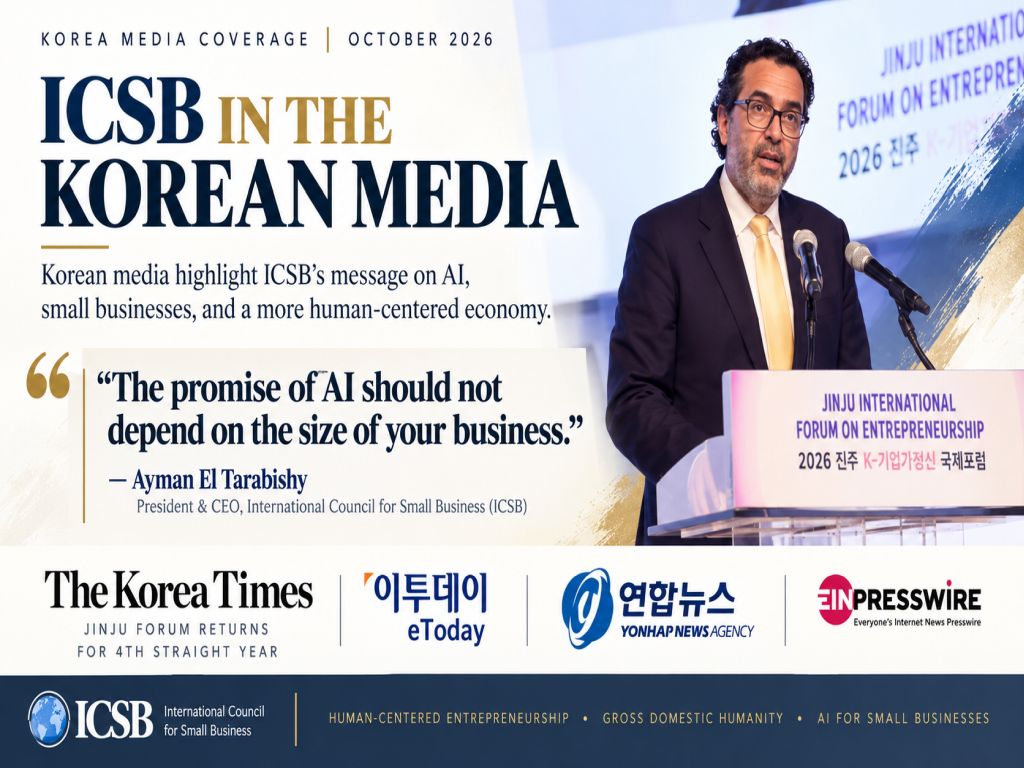
In Jinju, the conversation broadened as ElTarabishy addressed the future of entrepreneurship in the age of artificial intelligence.
The Korea Times featured his keynote address, including his warning that smaller businesses risk being left behind as AI transforms the global economy.
“The promise of AI should not depend on the size of your business,” he told participants. His remarks connected the GDH agenda to a practical concern: Economic and technological advances matter only when their benefits reach people and businesses across society.
Other outlets, including Yonhap News Agency and Chosun Biz, covered broader discussions of entrepreneurship, international cooperation, and technological transformation.
Taken together, the media coverage reflects a growing interest in an idea that ICSB has advanced for years: Entrepreneurship should not be measured solely by the businesses it creates or the growth it generates, but also by the opportunities it provides for people to thrive.
ElTarabishy’s international research and Kim’s leadership in Korea are helping bring that conversation from academic journals into national policy discussions and public debate.
The question now is whether these ideas can translate into meaningful change.
After all, the real measure of economic progress may not be how much a country produces, but how well its people live.
ICSB Media Intelligence | October 2026
Based on an exploratory analysis of Korean media coverage published October 6–20, 2026.