We live in a world that is ageing at an unprecedented rate. By 2050, more than 2.1 billion people will be aged 60 or older. Faced with this reality, the question I wish to pose today is not how we care for our older adults, but something more uncomfortable—and, at the same time, more just: why do we continue to view them as dependent when, in fact, they represent the most underutilized human resource on the planet?
Older adults possess something no other generation holds to the same degree: experience, judgment, and a knowledge network forged over decades. Yet, they face systemic ageism that shuts doors to credit, employment, and innovation. My proposal—and the central theme of this work—is that person-centered entrepreneurship, grounded in four non-negotiable pillars (empathy, equity, enablement, and empowerment), can serve as a rights-based framework. This framework can transform older adults from passive beneficiaries of social assistance into active agents of economic and social development.
Let me begin with a simple question: can you continue to contribute to society throughout your life?
That matters to the young. It matters just as much to older people because human flourishing should not have an expiration date.
For too long, when we talk about aging, we focus on what older people need: pensions, healthcare, dependency, the cost of an aging population. All of this is important. But it tells only half the story.
The other question is: what can older people continue to contribute?
An older person is not simply someone who needs protection. They may have knowledge, experience, skills, relationships, judgment, creativity, capital, and ideas. In other words, an older person is human capital. And human capital does not disappear on a certain birthday. Knowledge does not retire. Creativity does not retire. Purpose does not retire. Neither does the capacity to learn.
That is why I believe the next stage of Human-Centered Entrepreneurship must be Intergenerational Human-Centered Entrepreneurship.
Korea has shown the world what a society can achieve through education, entrepreneurship, technology and human capital. Within a few generations, it transformed itself. Today, like many of our countries, Korea is entering another historic transformation: its population is ageing. That is a challenge. But it is also an extraordinary opportunity.
The question is not only how we support a growing older population. It is how we enable older people to remain participants in society for as long as they choose. That moves us from dependency to participation, from cost to contribution, from ageing as a problem to ageing as part of the solution.
Imagine retirement as a transition rather than an ending: from managing a company to mentoring an entrepreneur; from building a business to investing in someone else’s; from acquiring knowledge to transferring it.
Now imagine a young Korean entrepreneur. He understands artificial intelligence and social media, but has never built a company. And imagine an older entrepreneur, with forty years in an industry. He understands customers, negotiation, and economic cycles. He knows how companies fail, and that not every good idea becomes a good business.
He asks: “What could we build?” He asks: “How do we make it work?” One brings the future; the other brings the lessons of the past. Together, they may create something neither could create alone.
That is intergenerational entrepreneurship. It is not charity. It is collaboration.
 It is also a question of rights. Older people should not be seen only through the lens of vulnerability. They are rights-holders, workers, entrepreneurs, mentors, investors and community leaders. The right to participate, to learn, to work when freely chosen, to contribute to one’s community: none of these disappears with age.
Small and medium-sized enterprises can be the bridges. They are close to communities and families. They offer flexible work and real mentoring. A retired executive can become an investor. A former business owner can help a new founder avoid mistakes that took decades to learn.
So we should ask not only how many people are working, but how many have the opportunity to contribute. Not only how long people live, but how meaningful those years are. Development is measured not only by output, but by participation and purpose.
This calls for a new social contract between generations. Young people should not feel that older generations are occupying the opportunities they need. Older people should not feel that society has decided their best years are behind them. The young need the experience of the old. The old benefit from the young’s energy. And society needs both.
Let me return to the image of the rocket. A young person says: “When I grow up, I want to build a rocket and fly to Mars.” Perhaps he has the dream. Perhaps an older person knows how to build the engine. Perhaps another generation knows how to finance it. The rocket belongs to the future, but generations build the future together.
The purpose of an economy is not simply to make people live longer. It is to help people live longer lives with dignity, purpose, opportunity, and the freedom to contribute.
That is the promise of Intergenerational Human-Centered Entrepreneurship. And that is how we ensure that no generation, and no person, is left behind or outside the future.
Argentina has worked, together with like-minded countries, to build international consensus on a convention on the rights of older persons. Today, many of the rights I have described (to work, to learn, to participate, to be free from age discrimination) are scattered across general instruments, with no binding norm that addresses them together. A convention would turn the principle that age should not be a barrier into an enforceable commitment. It would be the legal infrastructure for intergenerational entrepreneurship: the guarantee that no one is excluded from contributing because of a birthday.”
“A convention is not the opposite of entrepreneurship; it is what makes it open to every generation.”
Thank you,
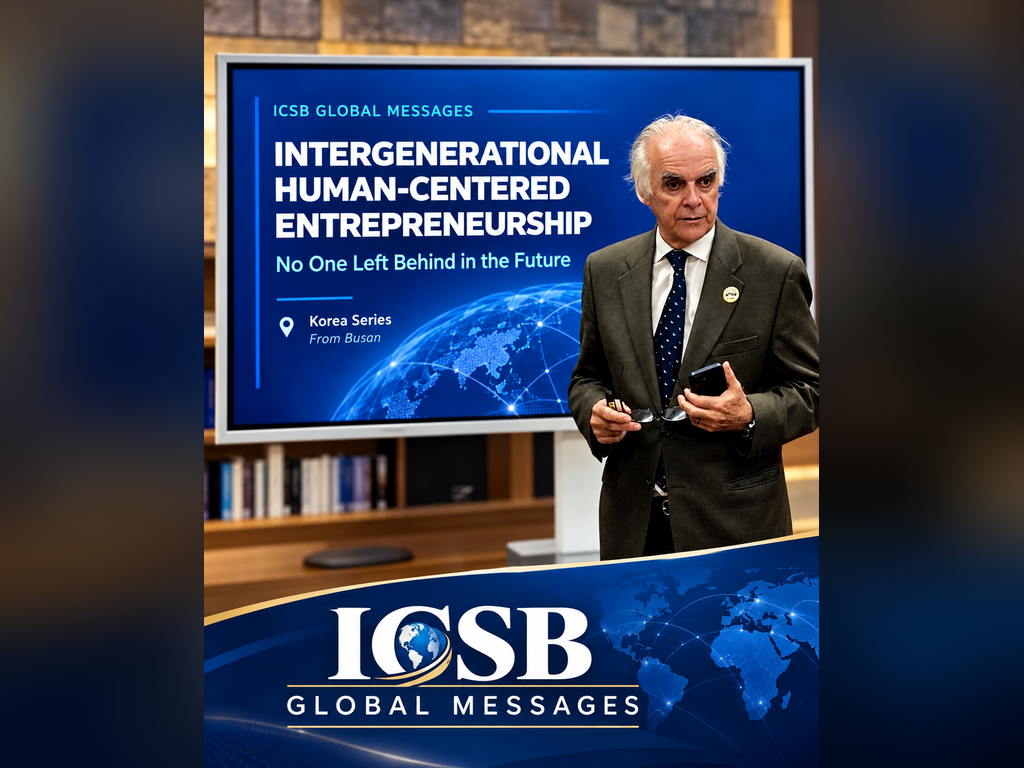
Ambassador Martín García Moritán, ICSB Ambassador and Fellow
***
Introducing ICSB Global Messages
From Global Conversations to Global Action
Following the Human-Centered Entrepreneurship Summit in Korea and the ICSB–OECD SME World Forum in Paris, ICSB is launching a new series to carry forward the ideas, insights, and perspectives emerging from these global gatherings.
ICSB Global Messages will feature original contributions from international leaders, scholars, entrepreneurs, and policymakers addressing the challenges and opportunities shaping our shared future.
The conferences brought us together. The messages will move us forward.