Reflections on EE in the Age of AI, Sustainability, and Human Purpose
by
Eugene Fregetto
7/10/2026
I have been involved in entrepreneurship education for a long time—long enough to remember when the field was still fighting for legitimacy. When I first began teaching entrepreneurship, the question many people asked was whether entrepreneurship could be taught at all. Was entrepreneurship a discipline? Was it a set of skills? Was it a way of thinking? Or was it simply something people either had or did not have?
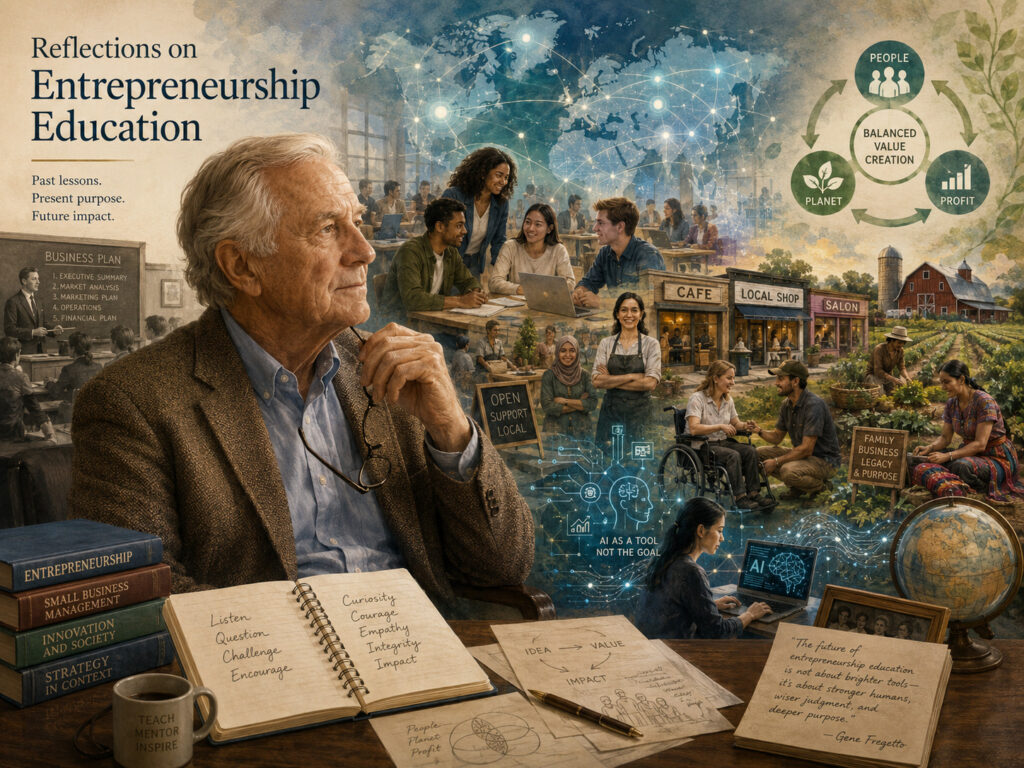
Over the decades, I watched those questions slowly lose their force as entrepreneurship education moved from the margins of business schools into the center of business education, economic development, and even university identity. Today, almost every college and university wants to claim some connection to entrepreneurship, innovation, creativity, or enterprise development. Centers have been created, courses have multiplied, pitch competitions have become common, and entrepreneurship has become one of the most visible words in higher education. Consequently, I find myself thinking that the most important question is no longer whether entrepreneurship can be taught. Instead, today’s most difficult questions concern whether we are teaching entrepreneurship well enough for the world our students are now entering. This is a very different concern.
For much of our history since the early 20th Century, entrepreneurship education focused on helping students learn how to start a business. We taught opportunity recognition, business plans, marketing strategies, financial projections, feasibility analysis, and venture launch. Those topics still matter. They are not obsolete. A person who wants to start a business still needs to understand customers, markets, costs, revenue, competition, and execution. But the world has changed. It has changed too much for entrepreneurship education to remain limited to the mechanics of starting a business. Today’s entrepreneurs must learn to create value in a world shaped by artificial intelligence, climate instability, social inequality, global markets, fragile supply chains, rapid technological change, and shifting expectations for business’s responsibilities. In that world, it is not enough to ask whether students can write a business plan or give a good pitch. We have to ask whether they can think, judge, adapt, test, listen, learn, and act responsibly under conditions of uncertainty.
I’ve always believed that entrepreneurship education lives or dies on the quality of the learning experience. We cannot simply tell students about entrepreneurship and assume they have learned it. Entrepreneurship is a performance discipline and does involve theory, method, practice, judgment, feedback, and reflection. A student can memorize all this knowledge and still be unprepared to act entrepreneurially. Our educational challenge is to help students develop the capacity to act when the situation is uncertain, and the answer is not already known.
Let’s take a glimpse of where entrepreneurship education is going—and, in my opinion, where it must go if the field is going to remain educationally and socially relevant.
Entrepreneurs’ Stories – It is important to allow students to hear real entrepreneurial stories, not as polished textbook cases, but as living accounts of people trying to create something of value in a specific context, because entrepreneurship is not learned only through definitions and models. It is learned through contact with people who are making decisions, facing constraints, adapting to uncertainty, and trying to move from idea to action. When students listen to entrepreneurs describe their journeys, they begin to see entrepreneurship as something more complex than a sequence of steps in a textbook. They see the hesitation, the adjustment, the persistence, the surprise, and the judgment required to create value; their learning becomes even richer, because they are not merely consuming information. They are asking questions, listening carefully, interpreting responses, and learning how entrepreneurs make sense of their own experiences. This is the kind of learning entrepreneurship education needs more of.
Experiential learning – It is important for students to gain hands-on, high-touch experiences, and we have many tools to provide them: podcasts, simulations, customer discovery, community projects, student ventures, international collaborations, and field-based assignments all help move students closer to the reality of entrepreneurial action. These experiences do not replace theory, but they give theory something to work on.
International collaboration – International collaboration is especially important for today’s students, giving them the opportunity to work on entrepreneurial problems with others from different countries, because students need to learn how to work across borders, across cultures, and across assumptions, helping them to understand that entrepreneurial problems are not abstract; instead, they are embedded in communities, histories, institutions, markets, and cultures.
Sustainability – Sustainability forces us to ask deeper questions. For too long, entrepreneurship education has been fascinated with starting a venture; a legitimate concern, but it is not sufficient. A business can start and still fail to create lasting value. A business can grow and still damage people, communities, and the environment. A business can still be profitable and yet fragile, irresponsible, or short-sighted. Yes, sustainability includes environmental responsibility, but it is broader than that. Sustainable entrepreneurship requires attention to the community, near and far. It asks whether workers are treated with dignity, whether communities benefit, whether resources are used wisely, whether the business can endure, and whether profit serves long-term value creation rather than becoming the sole purpose of the enterprise. I am not opposed to profit, as no business can survive without financial viability. But I have become increasingly uncomfortable with entrepreneurship education that treats profit maximization as the final measure of success. Profit is necessary, but it is not the whole story. In a sustainable business, profit becomes a means of continuing to create value. It is not simply the endpoint; instead, it is the search for answers to other important questions: Who benefits? Who is harmed? What costs are being ignored? What environmental consequences are being pushed onto others? Can the business model endure? What kind of future does this venture help create? These questions prompt students to consider the consequences of entrepreneurial action.
Practical wisdom – Many entrepreneurs already possess practical wisdom and production smarts. They have skill, discipline, and commitment. What they often lack is the business knowledge, language, structure, and confidence needed to turn their capability into a sustainable enterprise.
They may know how to make, grow, or cook something, provide a service, or serve customers. But knowing how to produce something is not the same as knowing how to build a sustainable business or understand the circular economy. One of the best things entrepreneurship education can do is help people recognize the significance of their own experience, giving them frameworks to understand their instincts and the credibility of their practical knowledge.
The disadvantaged – The disadvantaged include women, rural, minority, and immigrant entrepreneurs, along with persons with disabilities and persons living in indigenous communities. Too often, these persons are treated as peripheral to entrepreneurship; they are not peripheral; they are central. They go to the heart of what entrepreneurship education should be, because there is no generic entrepreneur. Every entrepreneur operates within a particular context that differs by gender, age, disability, geography, education, income, language, culture, family background, and access to networks and capital. A curriculum that ignores those differences may unintentionally reproduce the very inequalities entrepreneurship education should help reduce. If entrepreneurship education focuses only on high-growth start-ups, venture capital, and scalable technology ventures, it misses much of the real entrepreneurial activity that sustains communities. The key question is not how to create a separate category for the disadvantaged, but how to understand the barriers that prevent full participation. This is where entrepreneurship education must become much more sensitive to context. We cannot assume that the same curriculum, delivered in the same way, will work for everyone. If entrepreneurship education is truly about expanding human agency, then we must ask who has been denied that agency and how education can help restore it.
Artificial intelligence – (AI) is the most disruptive force entrepreneurship education has faced in my lifetime. AI is not simply another instructional tool; it is an innovation infrastructure and changes the conditions under which students learn entrepreneurship and entrepreneurs practice it. AI is not something we merely add to existing assignments; it changes the nature of the assignments themselves. Students can now use AI to generate business ideas, draft customer personas, prepare market analyses, create pitch decks, write business plans, produce marketing copy, build websites, simulate financial projections, and test variations of a concept. What once took them weeks to produce can now be done in minutes.
This makes AI both exciting and dangerous: Entrepreneurship educators must be careful. We cannot confuse polished output with entrepreneurial learning. AI can help students think, but it can also help them avoid thinking. A market analysis can sound convincing while having little connection to reality. The difference depends on pedagogy. In my view, the instructor becomes more, not less, important in the age of AI. AI can generate possibilities, but it cannot replace judgment. It can produce language, but it cannot validate demand. It can suggest strategies, but it cannot determine what is ethically responsible. It can simulate customers, but it cannot replace real customers. It can accelerate iteration, but it cannot remove uncertainty.
The right pedagogy will enable students to learn how to work with incomplete ideas, to form hypotheses, question assumptions, talk to customers, test concepts, revise models, and act without certainty. AI can help them do that faster, but it cannot do it for them. AI should not be used as a shortcut around entrepreneurial learning. It should be used to deepen entrepreneurial inquiry.
Innovation – “Disruptive or not?” is the question. We have been seduced by disruptive innovation because we like dramatic stories, breakthrough companies, and heroic founders. However, most innovation is incremental, in which entrepreneurial value is created by improving, adapting, making something easier, serving a neglected customer, reducing waste, or solving a practical problem more effectively. The truth is that most nascent entrepreneurs will not build the next Apple, Google, or Tesla. Instead, they are building restaurants, salons, farms, service firms, family businesses, tourism ventures, health ventures, educational programs, and community-based enterprises; these businesses fail to be newsworthy stories, even though they create jobs, serve communities, and give people agency over their lives. Entrepreneurship education must take incremental innovation seriously.
As I reflect upon my experiences, I see entrepreneurship education standing at an important crossroads. The field has grown enormously. It is more global, more visible, more experiential, and more interdisciplinary than it was when I first entered it. That progress is real.
However, if we continue to teach entrepreneurship as a set of business-planning exercises, we will fall behind the rest of the world. If we allow AI to produce the appearance of learning without its substance, we will weaken the field. If we continue to celebrate only high-growth start-ups, we will neglect the entrepreneurs who sustain communities. If we treat sustainability as an elective topic, we will fail to prepare students for the realities of twenty-first-century business. If we ignore the disadvantaged, we’ll reproduce the very inequalities entrepreneurship education should help reduce. Conversely, if we take these changes seriously, entrepreneurship education can become something much more powerful; it will develop agency, judgment, creativity, ethical responsibility, resilience, and the ability to create value under conditions of uncertainty. It will help our students see that entrepreneurship is not only about starting a business; it is about acting responsibly and creatively in the world.
