
Reflections on the Evolution of Entrepreneurship Education
1980 to present
by Eugene Fregetto, PhD
March 17, 2026
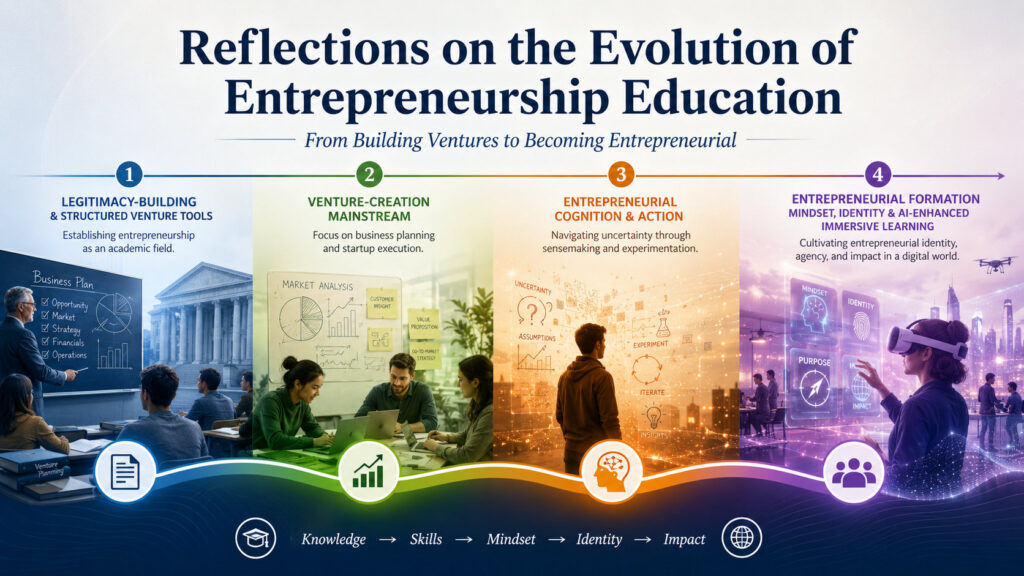
Entrepreneurship education has undergone a notable transformation over the past four decades. During the period from 1982 to 2014, when I taught entrepreneurship courses at DePaul University and University of Illinois Chicago, the dominant pedagogical focus in many programs emphasized the mechanics of venture creation. Courses were typically organized around identifying promising business opportunities, evaluating market potential, developing competitive strategies, preparing financial projections, and producing comprehensive business plans. These activities were designed to prepare students to launch and manage new ventures successfully. In retrospect, however, this pedagogical emphasis reflected not only the state of entrepreneurship education at the time but also the broader institutional history of business schools themselves.
Modern business schools were significantly shaped by mid-twentieth-century reforms that emphasized analytical rigor, disciplinary legitimacy, and systematic approaches to management knowledge. As a result, management education increasingly relied on frameworks, models, and techniques that could be taught, evaluated, and reproduced within classroom settings. Entrepreneurship education emerged within this institutional environment and therefore adopted many of its pedagogical assumptions. The structured tools of venture creation—market analysis, strategic positioning, financial forecasting, and formal planning—fit comfortably within the analytical traditions of business education. Consequently, entrepreneurship courses frequently revolved around these technical and strategic exercises.
During the formative decades of entrepreneurship education, this approach served several important purposes. First, it helped establish entrepreneurship as a legitimate academic field within business schools. By emphasizing analytical tools and managerial frameworks, entrepreneurship courses aligned themselves with the established disciplines of strategy, marketing, and finance. Second, these pedagogical methods produced tangible outputs that could be evaluated in classroom settings, such as business plans or venture proposals. Third, they provided students with practical skills directly relevant to launching and managing new ventures.
Within this framework, entrepreneurship education naturally centered on the question: How can we help students identify viable opportunities and successfully launch new ventures? The widespread adoption of business-plan pedagogy, venture simulations, and opportunity assessment exercises reflected this orientation. For several decades, this approach shaped the educational experiences of many entrepreneurship students and educators alike.
Yet with the benefit of hindsight, it becomes clear that this emphasis on venture mechanics often began the instructional process at a relatively advanced stage of entrepreneurial development. Courses typically assumed that students already possessed the cognitive and interpretive capacities required to think and act entrepreneurially. Students were expected to identify opportunities, evaluate markets, and develop strategic plans, even though the underlying capabilities required for interpreting uncertain environments were rarely addressed directly.
Recent developments in entrepreneurship scholarship suggest that this assumption deserves closer scrutiny. A growing body of research emphasizes that entrepreneurial action frequently occurs under conditions of uncertainty, ambiguity, and incomplete information. Entrepreneurs rarely begin with fully formed opportunities or clearly defined strategies. Instead, they must interpret evolving signals, revise assumptions as new information emerges, and construct coherent narratives of action in environments where outcomes remain uncertain.
These insights highlight a deeper dimension of entrepreneurship education that extends beyond the technical mechanics of venture creation. In addition to learning how to develop business models, evaluate markets, and manage resources, aspiring entrepreneurs must also develop the interpretive capacities necessary to navigate uncertain environments. These capacities include the ability to recognize patterns within fragmented information, revise interpretations when unexpected events occur, and maintain a coherent sense of agency while pursuing emerging opportunities.
My own appreciation for this deeper dimension of entrepreneurial development intensified after encountering the immersive learning framework known as Beyond TerraCore. What distinguishes this approach is that it begins not with the search for a business idea or the construction of a venture plan, but with the cultivation of interpretive capabilities. Participants are immersed in environments characterized by ambiguity, incomplete signals, and evolving narratives. Through cycles of sensemaking, disruption, reconstruction, and reflection, learners gradually develop the cognitive and interpretive capacities required to operate effectively in uncertain contexts.
From this perspective, entrepreneurship education can be understood as involving two related but distinct layers of learning. The first concerns the mechanics of venture creation—the analytical tools and managerial frameworks required to build and manage new organizations. The second concerns the formation of entrepreneurial agency—the developmental process through which individuals cultivate the interpretive judgment, resilience, and narrative coherence necessary for entrepreneurial action.
Traditional entrepreneurship education has focused primarily on the first layer. Students learn how to evaluate opportunities, design business models, develop strategies, and secure resources. These skills remain essential, and they continue to play a central role in entrepreneurship curricula. However, the emergence of immersive and experiential approaches suggests that entrepreneurship education must also address the second layer: the developmental formation of individuals capable of acting entrepreneurially in uncertain environments.
This broader perspective helps explain why entrepreneurship education is evolving in new directions. Scholars increasingly emphasize experiential learning, effectual reasoning, entrepreneurial mindset development, and identity construction as central components of entrepreneurial capability. These perspectives recognize that entrepreneurship is not solely a technical process of opportunity exploitation but also a cognitive and interpretive process of meaning-making under uncertainty.
Reflecting on my own teaching experience, I now recognize that the courses I taught during the formative decades of entrepreneurship education addressed an important but partial dimension of entrepreneurial development. By focusing primarily on the mechanics of venture creation, we often assumed that students already possessed the interpretive capacities necessary for entrepreneurial action. In reality, these capacities are themselves developmental achievements that require deliberate cultivation.
This realization does not diminish the value of earlier approaches to entrepreneurship education. The structured tools of venture creation remain indispensable for translating entrepreneurial ideas into sustainable organizations. Rather, it suggests that entrepreneurship education may benefit from a broader developmental perspective—one that integrates both the technical mechanics of venture creation and the deeper formation of entrepreneurial agency.
Seen in this light, the evolution of entrepreneurship education over the past several decades represents a natural maturation of the field. Early pedagogical models helped establish entrepreneurship as a legitimate domain of business education by emphasizing the analytical tools of venture creation. Contemporary approaches increasingly explore how educational environments can cultivate the interpretive, cognitive, and identity-forming capacities that enable individuals to act entrepreneurially in uncertain contexts.
Together, these perspectives suggest that entrepreneurship education ultimately involves more than teaching students how to launch new ventures. It also involves helping individuals develop the interpretive judgment, resilience, and sense of agency required to navigate uncertain environments and create new possibilities. In this sense, entrepreneurship education may be understood not only as instruction in venture creation but also as a developmental process through which individuals learn to become entrepreneurial actors.
Looking ahead, I believe AI will trigger a seismic shift in higher education—comparable to, and possibly greater than, the disruption Darwin’s Origin of Species created in academic thought. The difference is speed: Darwin’s ideas took decades and sustained struggle to reshape higher education, while AI’s “meteorite impact” is unfolding in months. In my view, higher education must reinvent its delivery model rather than retrofitting the existing structure. Attempting to modify the current system at the margins will not be enough—and may ultimately lead to failure.
